

Vacuum Conveyor Yields Higher Wages at Milling Operation
Case Study
Pneumatic automation of material transfer cut production time from 12 to eight hours and reclaimed previously lost product, freeing up financial resources to increase hourly wages.
Since running her own artisanal bakery where she baked breads in brick ovens with flour milled in-house, former baker, Jennifer Lapidus, now a miller and founder/general manager of Carolina Ground, a boutique flour mill located in Hendersonville, North Carolina, has let her business decisions be informed by the reality of how the labor of production feels.
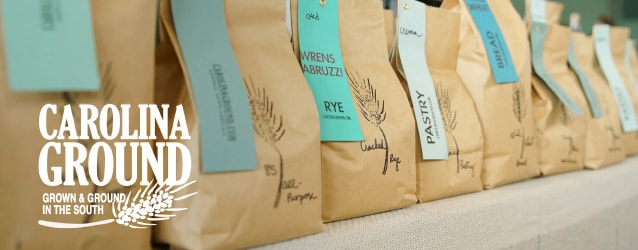
“I look at it through the lens of how we can be doing things better, more efficiently, easier on the body, and in a way that will make things better on more than one front,” said Lapidus.
One of the early pioneers in the revitalization of locally grown stone-milled flour production that connects the farmer, miller, and baker, Lapidus said there really wasn’t a modern example of this type of food production to replicate when Carolina Ground first opened its doors in 2012.
Like most startups, human capital and manual labor powered much of production. “In the beginning some of the ways we did things were archaic,” says Lapidus. “During our first year, a manufacturer’s representative for VAC-U-MAX visited and saw what we were doing with a single mill and a bucket elevator and let us know what was available for automated transfer, even though we weren’t in the position of buying a lot of expensive equipment.”
Known for their expertise in food-grade systems for major food manufacturers including General Mills, Kraft Foods, and Kellogg Company, as well as many smaller specialty food manufacturers, Belleville, NJ-based VAC-U-MAX specializes in the design and manufacture of pneumatic systems and support equipment for the conveying, weighing, and batching of dry materials.
With nearly 70 years of experience handling more than 10,000 bulk materials and powders, the company is a pioneer with many firsts, including developing the first venturi-powered vacuum producer that operates on compressed air.
Vacuum conveyors are inherently safer and more efficient than manual transfer of materials and some of the most common reasons that facilities implement them is to meet increased demand; mitigate ergonomic, fall, and fugitive dust hazards; reclamation of expensive materials; and improving product quality through precision ingredient delivery or by eliminating cross contamination.
Vacuum conveyor systems consist of four carefully selected components to fit a customer’s process and needs—a pick up point where material enters the system, a vacuum receiver (aka filter receiver) that collects transferred material, a vacuum producer that powers the system and a control module that regulates conveying cycles and integrates with other machinery.
As Lapidus gained her footing in the milling arena and her tiny mill’s orders were on the rise she began to look for ways to work smarter while still being intentional about how she grew and mechanized the mill.
Smart Solutions
One of the first upgrades for the mill was replacing the bucket elevator that fed grains into the hopper above the mill. Bucket elevators have many moving parts, such as belts, motors, bearings, and sprockets, making them costly and time-consuming to maintain—and dusty production environments reduce their lifespan and increase the risk of a combustible dust explosion.
Lapidus replaced the bucket elevator that fed grain into the mill with a small rotary airlock system from the manufacturer of her 48-inch stone mill. That system was more or less a generic option for transporting grains into the mill’s hopper, and frequently experienced clogs at a 90-degree elbow causing backups in production.
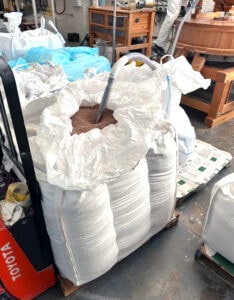
Often generic one-size-fits-all solutions don’t calculate for all conditions in system design, which can cause problems in performance; and, during their fifth year in operation, Carolina Ground purchased its first VAC-U-MAX compressed air-powered vacuum conveyor to feed grain from totes into a hopper above the mill. “It’s a simple system,” says Lapidus.
Compressed air-operated vacuum conveyors are by far the safest and most economical method for transferring powders and bulk solids as they have no moving parts and are, by design, intrinsically safe, generating no heat or sparks.
Where compressed air is not sufficient for an air powered system, or when conveying materials at higher rates and longer distances, alternative vacuum sources like positive displacement pumps or regenerative blowers are used as appropriate.
Though the milling operation was using a vacuum conveying system to feed grain to the mill, it was not capturing the flour exiting the mill efficiently and safely. The flour from the mill collected in buckets below the mill and then workers flipped the buckets over into bags, which were repetitive lift-and-twist motions that risked lower-back injuries.
When the mill was producing smaller quantities, this method was workable, but as the demand for Carolina Ground’s stone-milled flour continued to rise, the manual labor to transport 8000 pounds of flour per week from the mill became glaringly problematic. The position of miller was tough to staff.
“It’s really a burnout job. It was a lot of work,” says Lapidus. There were a couple times where, after one day on the job, workers decided that this work was not for them, despite that they bought into the burgeoning business concept of connecting local farmers, millers, and bakers. “It was going to take more than a love of the concept to keep our staff.” says Lapidus.
When the pandemic-related commodity flour shortage further drove up demand for Carolina Ground’s stone-milled flour on the retail end, Lapidus decided to do a full upgrade of the milling process during a planned move to a new facility that better suited the milling operation— now with a second mill—and provided a better working environment.
Again, for Lapidus, “upgrading the process was more about doing what we were doing better, more efficiently and providing a better environment for our millers,” she says. She had gained enough confidence in the market and the process to discern that “mechanizing in strategic ways didn’t dilute the craft element of what we were doing.”
“Our intent was to replace processes that weren’t working for us,” says Lapidus. “With the newest VAC-U-MAX systems everything just became a lot more efficient,” says Lapidus.
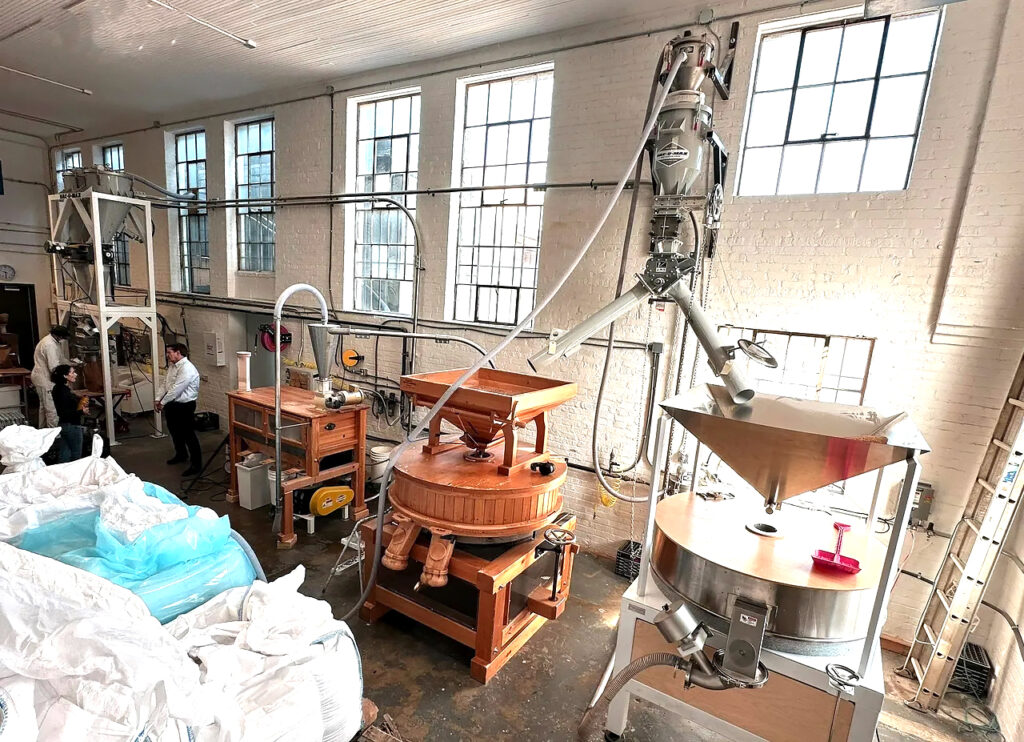
Carolina Ground now uses three VAC-U-MAX vacuum conveyors in their milling process—a venturi powered system to feed grain into the stone mills and two regenerative blower powered systems that transfer flour from the stone mills to a bagging system.
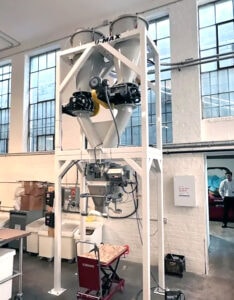
Each of the three systems has gravity diverter valves to give Carolina Ground the ability to use one vacuum conveying system to feed two different pieces of equipment. A gravity diverter valve acts similarly to a splitter valve, facilitating the use of one vacuum receiver instead of two. The gravity diverter valve has a blade inside that switches from one direction to another, allowing material to feed into the appropriate vessel.
The compressed air-powered system, designed to deliver grain from sacks into hoppers, can service both mills; a surge bin gives Carolina Ground the ability to batch feed with the system by closing off a bin in order to measure how much material is dropping into the hopper when they want to do any blending.
“I like the dual system. I didn’t want to have to have two of everything and VAC-U-MAX was able to make that happen for us.,” says Lapidus.
Although Lapidus didn’t want two of everything, she did want each of the mills to have their own conveying system to transfer flour from the mills. After having problems with that first airlock system clogging at the 90-degree angle in the pre-VAC-U-MAX years, she preferred the redundancy of two systems and the ability to shut one off when volume dictated. Carolina Ground processes flour on demand producing between 6000-12000 pounds per week.
The two regenerative blower powered vacuum conveying systems operate independently and each can feed two different packaging systems. “I’m really happy with having two separate systems. The whole project worked out really, really well,” says Lapidus.
“The VAC-U-MAX system is an amazing improvement. It has reduced our 12-hour shift down to eight hours, and because of that, we are able to pay everyone a little bit more per hour,” says Lapidus, “and our backs are in a lot better shape because there is a lot less heavy lifting.”
Shaving four hours from production and eliminating the need to physically transfer 8000 pounds of flour per week fits with Lapidus’ ethos of doing things better, more efficiently, and reducing wear and tear on the body. The vacuum conveying systems also delivered on the concept of doing something in a way that makes things better on more than one front: it reduced the amount of fugitive dust in the environment and enabled Carolina Ground to reclaim previously lost flour that collected at the bottom of the bucket elevator.
Fully enclosed vacuum conveying systems protect materials from air, dirt, and waste. Because product does not escape the system, particulates are prevented from entering the environment, where they can endanger workers’ respiratory health, or settle on equipment and surfaces, posing an explosion hazard.
Cleaner more ergonomic workspace, reduced waste, improved product quality.
These vacuum conveying systems have “profoundly reduced the amount of dust in the plant,” Lapidus says. “We still clean for an hour a day, but now we have very little dust, it’s easy.”
“And that lovely oily flour that we used to lose to the pig farmer with the bucket elevator is no longer lost with the VAC-U-MAX system. We are able to recapture it, cycle it back into our stream, and run it right through our product line—there is no loss,” says Lapidus.
“Everything that was so hard has just a become a lot easier with the VAC-U-MAX systems. We have less waste, we have less dust, and we have better quality product,” says Carolina Ground’s Lapidus.
Image gallery
San Juan Seltzer Brews Up Safety During Expansion
Case Study
Hard seltzer producer eliminates ergonomic hazards, meets demand, and simplifies process with a space-saving, sanitary vacuum conveyor.
When San Juan Seltzer launched its first production run in 2018, it became part of the spiked seltzer growth explosion and quickly secured its place as a dominant craft spiked seltzer.

With more than 60 years of cumulative beverage industry experience on the team, San Juan Seltzer was able to master this phenomenal growth.
“What started as an occasional brew, quickly became brewing all the time,” says Frank Commanday, technical director, at San Juan Seltzer. Commanday has over 30 years of practical experience in the beverage production industry and has been with the company since its founding.
With production nearly doubling each year, it wasn’t only the frequency of brews that increased; volume increased 3-fold. It was soon apparent that manual loading the cane sugar into the brew house mixing tank bag by bag was no longer practical.
With larger batches, a single fermentation run required just over three tons of cane sugar to produce the alcohol base for its spiked seltzers. “Manually loading 50-pound bags into tanks at that volume is just not workable,” said Commanday. “Not only is it inefficient and labor intensive, it is also potentially dangerous. Lifting and twisting risks back injury.”
Seeking a Solution

When seeking an automated solution, the seltzer producer had three primary considerations. First and foremost was to address the health and safety issue of workers manually lifting 50-lb sacks of sugar from a pallet up a flight of stairs to another worker on the platform, who had to open each sack and dump it into a mixing tank. The second was to free up personnel to perform other tasks. The third was to eliminate the need to bring pallets of sugar through the brewing area, where they impeded access to tanks, hoses and other equipment.
“Tried and true is the way to go,” said Commanday about choosing equipment. “First you look at the most common methods for a given operation, and then apply it to your process to meet operational goals and budget.”
In breweries, automating transfer of malted grains is commonly achieved with the use of low-cost augers. Commanday, however, discovered that augers could not handle granular sugar effectively, so he looked to the most common method of transferring granular sugar: vacuum conveying. “I contacted Vac-U-Max because it’s the original vacuum conveyor manufacturer,” said Commanday. “It has been around since the Fifties, with venerable, mature technology.”
With more than 65 years of experience in developing customized conveying systems across a wide range of industries, and testing more than 10,000 materials, Belleville, NJ-based Vac-U-Max has been at the forefront of innovative mechanical and pneumatic design with many firsts. Its systems perform sophisticated operations with little human assistance, delivering flexibility, integration, and efficiency to its clients.
With a history of working with major food and beverage manufacturers such as General Mills, Kraft Foods, and Kellogg Co., as well as many smaller specialty producers, Vac-U-Max has extensive knowledge in the design and construction of sanitary conveying systems that meet FDA and USDA standards.
Vacuum Conveying
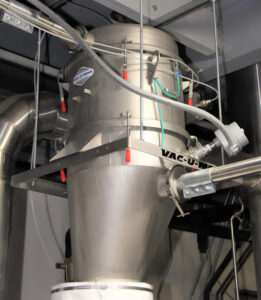
Vacuum conveying (aka pneumatic conveying) uses suction to transfer dry bulk materials and powders, gently and automatically through a tubing network easily installed within a facility. Versatile, small-footprint vacuum conveying systems easily integrate with existing processes by routing conveying lines between floors, through partitions, and around machinery, and can easily be re-routed to accommodate process modifications.
Vacuum conveying systems include a pickup point where material enters into the conveying system, convey tubing that transfers material between equipment, a vacuum receiver (aka filter receiver) that serves as an intermediate holding vessel for materials, a vacuum source that powers the system, and a control panel that tells the system how to operate.
Sanitary and hygienic vacuum conveying systems have the same five basic components as standard conveying systems but are constructed with materials and fabrication techniques that meet Current Good Manufacturing Practices (cGMPs).
The pick-up point is the most customized component in a vacuum conveying system and is dependent upon the type of container that holds the transfer material. This dictates whether the pick-up point in a conveying system is a wand, a bag dump station, a bulk bag unloader, or a feed bin.
After choosing a Vac-U-Max system to automate the process of discharging sugar into the mixing tank located in the brewhouse area, with the pickup point in an adjacent room, Commanday chose the best alternative to 50-lb bags for its process.
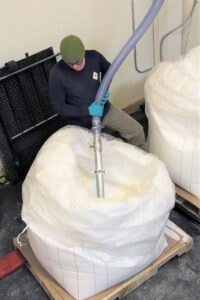
Bulk Container Options
Automating manual materials handling with vacuum conveyors provides users with wider variety of bulk containers to best fit their unique process and budget. The seltzer company could have stuck with its 50-lb bags and added a bag dump station as the pick-up point, but doing it this way still required manual handling of 50-lb bags which the company wanted to eliminate completely.
For the seltzer manufacturer, 2,000-lb flexible intermediate bulk containers (FIBCs), or supersacks, were the most economic and efficient way of storing and transporting sugar for its process. With 2,000-lb supersacks, Commanday had the option of suspending them from a customized bulk unloader with a rotary valve metering the sugar into the vacuum conveyor.
Bulk bag unloaders provide an easy, clean, and economical way to discharge the entire contents of bulk and semi-bulk bags, especially when the material is less than free flowing. Vac-U-Max customizes each bulk bag unloader to integrate with a customer’s process.
In situations where space and/or cost are considerations, the use of a wand, inserted into a supersack (moved into position with a pallet jack or forklift), provides the simplest solution. Commanday opted for the most inexpensive, low-tech method, using a stainless steel wand to draw sugar from the top of the supersacks into the vacuum conveying system. “A single operator holding onto the wand is far better than having two people lift, carry, load, open, and dump 120 50-lb bags,” he said.
Labor Savings & Improved Working Conditions
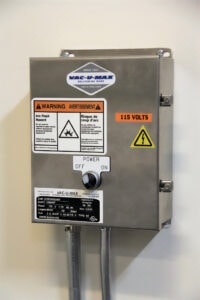
While automating the loading cycle with the vacuum conveyor did shave a little time from the process, the real savings came in terms of labor. “I suppose you could say that it takes half the time now since it only requires one operator and not two,” said Commanday. “But the best part is, is that you don’t have people ruining their backs or having to contend with pallets blocking the production area, so the Vac-U-Max system is far more efficient overall. I also really liked and appreciated the service that I got with Vac-U-Max.”
Following Up
After nearly two years in service Commanday emailed Vac-U-Max with questions about his system. Although it had been performing well, caked sugar had accumulated around the filters and the vacuum gauge read 4 in. of suction without a load, indicating some blockage of the filters.
The solution was simpler than he anticipated. The filters are cleanable in-situ with warm water and then left to dry. “Those seven filters are robust, they aren’t going collapse, they don’t need to be changed all the time, and they are efficient,” said Commanday. “It will be a long time before we need to replace them.”
“The Vac-U-Max system has been a real workhorse. It is robust, low maintenance, and very simple to use.”
Image gallery
Maximizing Carryover Improves Packing Quality & Bottom Line for Tea Manufacturer
Case Study
Vacuum conveying retrofit reduces 70-80 percent of tea dust, improving quality and reducing housekeeping.

Vacuum conveying is very common in the food industry and while most suppliers say they can move product from point A to point B, there are some applications that require deeper knowledge to thoroughly assess and meet all requirements for ergonomics, safety, efficiency and quality control.
In an ongoing project to improve processes whenever and wherever it can, a global manufacturer of private label retail, foodservice, and specialty brand teas, purchased an extension conveyor system to improve efficiency and ergonomics.
Starting point
Prior to implementing the extension conveyor, a vacuum conveyor system transferred raw materials into portable silos that workers rolled from one production machine to the next. The finished product was then transferred from silos to packaging machines using a VAC-U-MAX packaging vacuum conveyor.
The new extension conveyor system, from another vendor, transported raw materials from large bags that workers cut and introduced into the conveying line. Once in the conveying line, material moved through the production process and the finished product conveyed to mobile silos. The packaging conveyor, in use for 10 years, then transported the final product from mobile silos to packaging machines.
The tea manufacturer produces multiple grades of teas and the new extension conveyor system generated a higher volume of fine particles in the final product of its high-grade whole leaf tea products, resulting in a quality control issue.
Although the extension system vendor appropriately sized the system to gently move the whole leaf tea through the system, smaller particles (introduced into the system as a result of breakage during transportation of raw materials from suppliers) further degraded while traveling through the extension system, creating fine dust.
In addition, purging filters in vacuum conveying systems forces some dust back into the receivers and therefore the product, which in most industries isn’t an issue. After unsuccessful attempts to remedy the problem with the vendor of the extension conveyor system, the tea producer contacted VAC-U-MAX for a solution. After consultation, it was clear that the other vendor’s system wasn’t pulling off the fine dust the process was creating, so all entrained dust remained in the product and carried along the entire process.
Finding a solution

The fine tea dust, up to 200 microns in size, is very receptive to static charge and was clinging to the inside of the cellophane packaging that wrapped around the boxes resulting in quality control issues and increased costs through lost product, cleaning times, and wasted production time. The dust is just part of the product, but the company did not want to introduce it to the packaging machine because it makes cleaning and sanitation difficult. The inherent nature of fully enclosed vacuum conveying systems prevents loose powder and dust from becoming airborne contributing to a cleaner and safer environment all around.
Vacuum conveying systems are fairly simple, consisting of five basic parts, a pick-point where material enters into the conveying system, convey tubing which transfers material between equipment, a vacuum receiver (typically equipped with a filter, and therefore often referred to as a filter receiver) which is an intermediate holding vessel for materials, a vacuum source that powers the system, and a control panel that tells the system how to operate.
In essence, larger more sophisticated vacuum conveyor systems that connect multiple processes consist of several conveying systems (without the need for multiple power sources or control systems) and therefore require multiple vacuum receivers. Vacuum receivers are the second most modified component in a conveying system, after pick-up points, and are an integral part of conveyor performance.

Dialing in the design
When dealing with dust, system design requires interpretive consideration of multiple factors to reduce exposure and those factors change with each material, application, and process.
In industries where equipment is taken apart and cleaned on an hourly, daily, or weekly basis, like food and pharmaceutical processing, the use of filterless receivers, or cyclones (a specific design of filterless receiver that operates in a different manner), in combination with a filter separator can reduce housekeeping times, improve product quality, reduce the possibility of cross-contamination and help with allergen control.
The most common reason for including filterless cyclones in conjunction with filter separators is to eliminate the need to clean, maintain and replace six or eight filters from receivers that sit above equipment. The filter separator is located remotely on the ground for easy cleaning and located away from areas where dust can pose problems.
In those types of situations, there is an extra unit sitting on the ground and each of the units on the silos have airlocks instead of filters. It can be done without the expense of additional equipment but there is still dust in the product, which for many industries is not an issue. In fact, most companies want to minimize the amount of carryover of materials, but this application required maximizing the amount of dust captured. Carryover is the amount of product collected in the filter separator to separate the air from solids (dust) inside a vessel to prevent solids from reaching the vacuum pump.
Success in the testing lab… and on site
The retrofit to the other vendor’s extension system included design principles similar to the 10-year old packaging system that uses two filterless receivers that share a common filter separator to pull off the fines—except for the magnitude of scale. During the testing phase for the retrofit, the raw samples looked pretty clean before going through the system and the veteran conveyor experts knew that only full-scale testing could prove the reduction in fine particle dust. A visual inspection of the raw samples before conveying and the after samples showed a marked difference in how much nicer the end product looked.
After factory acceptance testing, a pre-engineered system arrived at the tea manufacturer with several retrofitted filter separators to integrate with the extension system to remotely maximize the amount of carry-over of tea dust drawn away from the extension system. The retrofit eliminated 70-80 percent of the fine dust from the product and the customer gained throughput because there is the better product going to the packaging machines, less clean up needed, and no wasted production time.
Image gallery
Powdered Egg Company Implements Energy-Saving Pneumatic Conveying System
Case Study
Reduced maintenance and energy costs + greater efficiency = $150,000 in annual savings.
Nutriom sets the bar high when it comes to producing its premium quality, natural powdered egg products. Their Ova Easy Egg Crystals® are sold at outdoor retailers such as REI and online merchants such as Amazon.com. When the screw conveyor in their FSIS USDA facility required regular unexpected attention, Leonardo Etcheto, Plant Manager at the Lacey, Washington facility knew it was time to look for a better solution.
Seeking a Unique Conveying System

Nutriom developed a unique process to produce its egg products which preserves the flavor and functionality of the eggs, and needed a materials handling system that would work within that specialized process to improve efficiency without damaging the crystals.
“The screw conveyor was a difficult system to handle,” says Etcheto. “There were a lot of moving parts and that meant there were more things that could go wrong. It was a difficult system to clean and to perform maintenance.”
Improved efficiency and gentle transfer weren’t the only provisions Etcheto required. “Our technology is very different and we’re a little pickier than your average company. We needed a conveyor manufacturer that was able to modify its equipment to meet our needs,” he says.
When attending a trade show for food manufacturers, Etcheto visited the booths of conveyor manufacturers. “We wanted something that would not touch the product, allow us to be full stainless steel, and one of the biggest things is we wanted to get away from having to use oil,”.
The food-grade screw conveyor at the Lacey plant had a plastic housing outside the screw conveyor. Plastic components from equipment in the food industry hold the potential to deposit debris or shavings into product undetected, and Nutriom preferred to eliminate that potential. The screw conveyor also housed a gearbox on top of the unit that required expensive H1 lubricants that on occasion, despite regular maintenance, would leak and create a mess.
Pneumatic Conveying Protects High Quality Products
After contacting a couple of East coast pneumatic conveyor manufacturers, Etcheto decided that one of the manufacturers could accommodate all his requirements. “We have a lot of height restrictions because our building is older and has many areas with low ceilings and VAC-U-MAX was able to come up with a system that could fit in the space that we needed to fit into.”
Celebrating its 60th year designing and manufacturing innovative pneumatic conveyor systems and support equipment for the conveying, weighing, and batching of dry materials, Belleville, NJ-based VAC-U-MAX is a pioneer with many industry firsts including air-powered venturi power units, direct-loading of vacuum-tolerant process equipment, and vertical-wall Tube Hopper material receivers.

Etcheto began with one pneumatic conveying system from the company and, based on its successful performance, “we just kept adding,” he says. The facility utilizes two pneumatic conveyors that connect to packaging systems, two that connect to the low temperature driers and two that connect to a mixer -one system breaks up the powder and puts it into the mixer and the other pulls it out.
“One of the reasons we use pneumatics is because we produce a very high quality, high priced product and we want to make sure that we maintain the high quality. The systems do a good job pulling the product without damaging it.”
Previously, the screw conveyor would grind the egg product down as it transferred the material which made the crystals more difficult to handle. The screw conveyor also needed a fair amount of egg to be in the system for it to work properly which would sometimes bog down the process.
“The enclosed system allows for more ideal handling,” says Etcheto. “It’s standard GMP to make sure that nobody is handling our product, and the system easily allows us to do that. It is always traveling pneumatically through stainless lines,” he says. “It is definitely cleaner than the screw conveyor we used before.”
Experience with Food Manufacturers
VAC-U-MAX vacuum conveying systems are fully enclosed, protecting materials from air, dirt and waste. Because product does not escape from a vacuum conveying system, particulates that can endanger or jam expensive equipment are prevented from entering the environment.
Having worked with a host of major food manufacturers including General Mills, Kraft Foods, and Kellogg Company, as well as many smaller specialty food manufacturers, the conveyor manufacturer is no stranger to the strict regulations that exist in the food industry. This expertise lent itself to understanding the needs of Nutriom and the creation of a custom system that was more efficient, reduced labor, improved ergonomics, and made compliance with stringent FSIS USDA regulations simpler.
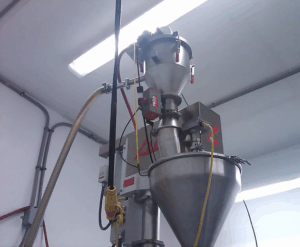
The vacuum conveying systems are complete stainless steel construction and all product contact areas are 316L with a polished surface for ease of cleaning and product flow. Nutriom utilizes two separate types of vacuum generation to accommodate its unique process. For areas with low ceiling clearance VAC-U-MAX modified its filter lids to fit the tight spaces and these units use compressed air to generate vacuum. In areas where ceiling height is not an issue, more efficient vacuum pumps are utilized.
To further accommodate Nutriom’s stringent standards, the conveyor manufacturer replaced the iron rings that secured the filter with stainless steel rings. Etcheto says, “they’re cleaner, fit better within our inspection system and last a lot longer.”
In addition to streamlining materials transfer and enhancing sanitation practices, the system has also improved ergonomics in the plant. “One of our systems only moves the powder about 10 feet, but it moves 10 feet up. Before implementing the pneumatic conveyors, the material had to be transferred manually and now that’s not an issue,” says Etcheto.
In the beginning, there was a learning curve, he says. “You’ve got to set them up right. You can’t have tight turns, you need the right amount of air flow, but once you figure them out, they really aren’t that complicated.”
Etcheto appreciates that the VAC-U-MAX system uses standard dairy wiring with all 30A clamps, and says that operators do most of the maintenance themselves and have no issues keeping the systems running. The systems he says are “easy to put together and take apart because they use standard parts the operators are used to, and they don’t need tools.”
“Over time, it’s really been surprising how reliable the VAC-U-MAX systems are,” says Etcheto. “With the screw conveyor, we had to do something to it at least once a month. By replacing it with a pneumatic conveying system, we have saved over $150,000 annually. That is really good technology.”
Image gallery
Moving Toward Sustainability
Tech Article
New conveying systems and belts are key players in bakers’ and snack manufacturers’ efforts to make their facilities and operations more sustainable.
Article Reprint: Snack Food & Wholesale Bakery Magazine
Written by: Romy Schafer, Managing Editor

Sustainability continues to be a priority for bakers and snack manufacturers for a variety of issues: Federal and state regulations are requiring manufacturers to be more energy efficient and reduce waste. Consumers continue to scrutinize the ingredients in their foods and question aspects like how “processed” they are. Rising energy and supply prices are prompting companies to look for new ways cut costs.
The key to addressing many of these sustainability issues, more bakers and snack producers are discovering, is investing in equipment—including in conveyors and belts designed with efficiency in mind.
Sustainably sanitary
Pneumatic conveying systems, for instance,are commonly used to recycle excess toppings— sugar, salt, sesame seeds, cornmeal, chopped nuts and more—from conveyor belts for refilling topping spreaders with “excellent economic return and reduced waste product,” says David Kennedy, Business Development Manager, VAC-U-MAX, Belleville, NJ. The conveying systems also can be used to transport individually wrapped products to bagging or carton-filling machines.
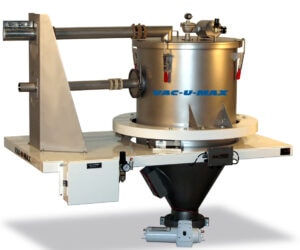
VAC-U-MAX’s pneumatic batch-weighing hopper feed systems convey major, minor, or micro ingredients, such as powders, granular food ingredients, nuts, and other bulk ingredients, that allow minimal product degradation when pneumatically conveyed. The systems can convey ingredients from drums, bags, bulk bags, intermediate bulk and flexible intermediate bulk containers, or super sacks, as well as discharge ingredients to packaging lines or other destinations.
The systems offer dust-free operation, allowing for safer and cleaner plant environments. Controls let operators select batching times or desired destinations, while a tool-free design facilitates maintenance and easy batch changeover.
“The ability to create recipes based on preprogrammed formulations allows processors to save on food ingredient costs over time, allowing for greater inventory control and overall end-product cost savings,” says Kennedy. “In some instances, expensive ingredients can be tweaked as a result of increased accuracy of food ingredients going into the process, ultimately saving time and money on ingredient costs.”
To read on, download the full article below.
Image gallery
Vacuum Conveying System for Tea: Steeped in Tradition with Modern Sensibilities
Traditional Medicinals finds pneumatic conveying answer to move blended product gently.
With over 34 years in the herbal supplement arena, Traditional Medicinals has combined the ancient art of traditional formulating with the most modern scientific methods of quality assurance and production, and remains dedicated to preserving earth’s natural resources, both human and natural.
 Already a leader in sustainability, and operating 70 percent from solar power, the company continues its commitment to preserving human resources by continually improving the work environment for its employees, striving for the most desirable and safe workplace.
Background
At the facility that operates 20 hours a day, four days per week to produce 2 million teabags per week, raw materials are brought in from around the world in already tea cut form. They are then reinspected and repackaged into barrel containers to feed into the blenders via a hopper system. Once the formulas are blended, they are transferred to the packaging area where they are gravity fed from a mezzanine level to IMA machines that process between 135 and 185 teabags per minute.
The Ask: Less strain on workers and increased efficiency while avoiding product loss or breakage
While working on a major efficiency project that culminated in the building of new rooms for the blending area Mary Goff, Plant Manager, says that the company also wanted “to cut down the amount of lifting that the operators were doing manually in our production department.”
Previously, the operators were weighing individual hundred pound batches into barrels, taking those barrels up to the top level, and then dumping them into hoppers manually by hand. In search of a better method, the VP of Quality Control and the Site Manager researched open conveyor systems as an ergonomic solution for transferring the raw materials.
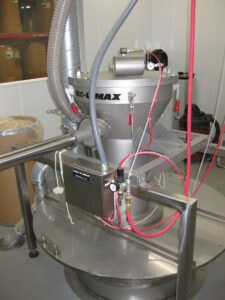
Traditional Medicinals uses pharmacopoeial grade herbs and one of its biggest concerns was how to transfer the herbs and blends from one area to another without breaking down the product or losing any of it.
“We did a lot of studies up front,” says Goff of choosing the right systems to transfer ingredients. “We spoke with some of our raw materials vendors about the systems they used to transfer materials and a gentleman from the consulting firm we were working with on the efficiency project told us about Vac-U-Max.”
A pioneer in vacuum pneumatic conveying, Belleville, NJ-based Vac-U-Max specializes in the design and manufacture of pneumatic systems and support equipment for the conveying, weighing, and batching of dry materials in the pharmaceutical, chemical, and food industries.
Although Traditional Medicinal’s herb suppliers warned against pneumatically conveying the herbs thinking that it would damage the ingredients, the information Traditional Medicinals pulled from the Vac-U-Max’s website convinced them that the method was worthy of investigation.
Pneumatic conveying systems have many advantages over open conveying systems such as belt or bucket conveyors. Ease of cleaning and the smaller footprint of pneumatic conveying systems are two of its biggest advantages.
In addition, pneumatic conveying systems are fully enclosed, protecting materials from air, dirt and waste. Because product does not escape from a pneumatic conveying system, particulates that can endanger or jam expensive equipment are prevented from entering the environment.
Although the advantages of the pneumatic system in theory seemed to outweigh the open systems, Traditional Medicinals needed assurance that the vacuum system would perform reliably without breaking down the product.
Try Before You Buy: The importance of working with an expert and a testing lab
“If the product is too fine it creates problems with separation and blending and also creates problems with packaging if it is too dusty,” says Goff. “Before purchasing the equipment, we wanted to be sure that it could transfer the product correctly and that it was holding its integrity from a quality standpoint.”
Vac-U-Max offers testing at no charge to potential customers in their fully functional state-of-the-art 6,000 square foot test and demonstration facility equipped to conduct a plethora of vacuum conveying tests to simulate the actual conditions at a customer’s site.
After consultation with the company to arrive at system design and equipment specifications, Goff traveled with the VP of Quality Control and the Site Manager to New Jersey to test the equipment with 15 of the company’s raw materials. “They spent a whole morning with us running through the testing making sure that we were happy with their equipment,” she says.
“One of our biggest concerns was the breakdown of the materials themselves and that’s one of the negatives that we kept hearing from our herb suppliers, but Vac-U-Max assured us that it wouldn’t. And they’ve proven that it is a very gentle way to move product,” says Goff.
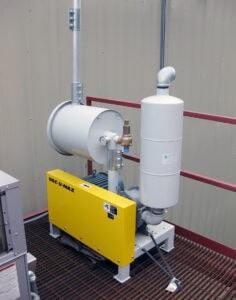
During the testing, it was determined that the three filter system initially specified for the application was capturing more product than desired so Vac-U-Max came up with a single system filter instead and adjusted the flow rate. “We we were able to get it to the point that we were satisfied with it and that didn’t take much effort at all.”
Because Traditional Medicinals runs between three and four blends per day in the department, Vac-U-Max set the company up with a cloth-type cleanable filter that is able to be cleaned, sanitized and reused. The company has several filters on hand for each blend.
Implementation
When the new blending area was finished, the Vac-U-Max system was implemented into the new process where raw materials are brought in and taken to a second level where they are run through magnets and then scaled into a barrel. The pneumatic conveyor system transfers the product back up to another room where the system performs as the hopper feed for the blender itself.
Now rather than operators using forklifts to bring barrels up to the mezzanine level, and manually scooping materials into the hopper, operators insert use a wand into the barrels and product is pneumatically transferred from the wand to the blenders.
“The system has eliminated all the forklift traffic, and from an ergonomic standpoint it’s saving a lot of wear and tear on our blenders’ backs,” says Goff.
In addition to creating a better ergonomic environment for the operators, Goff says “their system is more efficient too, and we are really happy with that side of it.”
Increased Efficiency
Although Traditional Medicinals has only been working with the new system for 30 days performing a full protocol of validating the equipment, process and cleaning procedures, Goff says, “I am predicting that we’ll be able to improve capacity by 20 percent.”
Cleaning and Maintenance
When running three or four blends a day, ease of cleaning quickly becomes an efficiency point when sanitation between runs is required. For this application, the Vac-U-Max system has a food-grade polished surface for effortless cleaning and product flow; and, all systems are equipped with heavy-duty clamps that enable quick take apart without tools.
Goff says, “it is very easy to take it apart. We’re taking it apart three to four times a day and we change the filter between each blend.”
Overall Goff says, “Vac-U-Max was very helpful and spent time to make sure the system worked for us. With the pneumatic system transferring the materials is a lot quicker and we expect that it will work well when we bring in a higher capacity machine later this year.”
Image gallery
Pneumatic Conveying Solutions for the Packaging Industry
Case Study
Three different packagers discover the efficiency, cost savings, and increased production available through pneumatic conveying.
This case study was originally printed in Packaging Digest, October 2008.
With all the buzz about lean manufacturing and automation, it’s surprising that more companies haven’t integrated pneumatic conveying into their production lines.
A Packaging Digest benchmark study called Automation in Packaging revealed that 94 percent of packagers believe that flexibility and automation provide competitive advantages, yet many packagers and processors still use manual processes and outdated equipment that eat away at precious revenue.
With today’s economic pressures, more plant managers and others charged with conveying powders, granular items, and flakes for packaging are adopting the automatic operation of vacuum conveying and packaging equipment as standards to hit critical price points for market success.
When contemplating the move to automated processes, those charged with streamlining production cite cost, flexibility, reliability and product quality among their top concerns. First and foremost among those concerns is how the process will affect product quality, as the moving of powder can potentially change its size, density, and texture.
Case 1: Preserve and Protect

Pacon Manufacturing, a US-based contract manufacturer and product converter for the consumer, medical and industrial markets, had to consider this when a particular project required high-speed conveying and dispensing of a blended powder into two layers of nonwoven material.
The nonwoven material was being ultrasonically sealed after the powder was dispensed. The product, a facial care application that had self-lathering properties, could be critically affected by how it’s conveyed to auger fillers. If the powder particles became too small, the product would self-lather too fast upon use. It the particles became too large, the self-lathering process took too long. Changing the density, component blend and texture would produce inconsistent fill rates or volumes-both unacceptable by quality control standards.
“Because product manufacturing speed ultimately sets the price, our goal wasn’t only to develop the product but also to develop a process that maintained quality at the necessary price point,” says Pacon’s vp Mike Scaduto. “To do this, we had to minimize labor while meeting stringent consistency requirements for moving and dispensing our powder at high volume.”
Pacon investigated traditional ingredient-transfer methods but found these had drawbacks for the application, including production interruptions and a degraded particle size.
A positive air-based conveying system looked promising, but disrupted the product’s particle size too much when the product was transported through piping.
Like the other methods Pacon considered, the air conveyor would have occupied more production space than Pacon desired, and might have been difficult to sanitize with a 70-percent alcohol/water solution.
The system that satisfied all of Pacon’s needs actually turned out to be pneumatic. Supplied by Vac-U- Max, the system consists of two low-profile drum-dump stations for easy loading, powered by a negative vacuum through conveying line piping to the three auger fillers. One drum dump station supplies powder to a single auger filler, while the other supplies the remaining two auger fillers.
Easy to Maintain
Because the powder can change density in the auger filler head, leading to improper fills, keeping the head full and at proper density is critical. To maintain proper powder density in the auger filler heads and affect accurate fills, Vac-U- Max mounted powder receivers with customized multi-filters above the auger fillers. Vac-U-Max also applied a high polish finish to the conveyor interior and exterior, reducing powder sticking inside the system and rendering the exterior easier to clean.
Vac-U-Max modified the powder receivers to help transport the powder without degradation, and customized standard components to fit the processes and product, reducing the potential that the powder would degrade and maintain powder quality. In addition, a device checks the powder level at each of the three auger filler hoppers. When more powder is needed, predetermined volumes of powder are automatically delivered to the hoppers.
The system is designed for ease of maintenance. The modular conveyor pipes have a specially designed receiver for quick, tool-less assembly/disassembly and easy cleaning. The drum-dump stations are fabricated with no crevices and few welds. Interior bends and corner welds have a minimum ‘/a-in. radius to minimize material accumulation.
A line discharger purges the conveyor at the end of each conveying cycle to prevent fallback of the powder and make restarts easier.
Upon the conveyor’s installation, Vac-U-Max worked with Pacon to adapt the system to Pacon’s needs. Instead of hanging the conveying pipe from the ceiling or supporting it from the floor, Vac-U-Max suspended it over Pacon’s equipment so i that it requires no floor space and can accommodate a vertical receiver-adjustment mechanism designed by Scaduto. The result is a modular system that can also be relocated, if Pacon desires.
Case 2: Plug and Play for Coffee

Café Soluble is a producer and packager of roasted ground coffee located in Managua, Nicaragua. Like Pacon Manufacturing, they had also considered mechanical conveying systems. But it rejected those methods, including a hybrid system of screw conveyors linked with a batch scale, because they took up too much space or they lacked the flexibility Café Soluble desired.
After the company experienced exponential growth, however, Café Soluble’s plant manager, Ernest Hurtado, assisted in overhauling the manual operation that had handled all of the plant’s batching, blending and intermediate steps. “We had an army of people moving cases [of coffee] around,” he says. “We grew so quickly that we couldn’t perform all of the material handling.”
When evaluating options to improve the material handling, batching and blending steps, Café Soluble sought a system that could grow along with it and still fit within its budget.
“We knew that at some point, we would have to change the design and move thing; around a little bit,” adds Hurtado. “But a screw conveyor or a bucket elevator would require a lot of production space.”
The Vac-U-Max system fit within the company’s requirements. Like Pacon Manufacturing., Café Soluble chose pneumatic conveyors that are “very mobile,” says Hurtado. “You just plug in an air connection, and you’re ready to go. You just need suitable overhead support, which can be as elegant or as crude as you like. But it’s a very flexible system.”
Café Soluble overhauled its material- handling and batching systems with the installation of six vacuum receivers. Two of them are outfitted with load cells and a weight control system and function as weigh hoppers over two blenders. The other four vacuum receivers are installed in pairs, with a pair on each of two hoppers that feed the coffee-packaging machines.
The installation has virtually eliminated manual material handling, relates Hurtado.
Café Soluble’s coffee-packaging operation begins at a grinder that discharges the ground coffee into small hoppers, each dedicated to a particular coffee variety. As the coffee fills the hoppers, vacuum receivers over the blenders generate negative pressure and pull the coffee from the various hoppers through a series of conveying lines.
Mix and Blend
When the company’s coffee reaches the end of a line that stretches 10 meters long, a vacuum receiver is filled until the target weight is achieved. Typically, a Vac-U-Max vacuum receiver will pull 20 pounds (9 kg) of coffee from a hopper before discharging it to the blender below, Hurtado says. By repeating the operation 16 times, the batch grows to 320 pounds.
A worker then makes minor manual additions to finish the coffee recipe, and the blender mixes that batch of coffee. As that blender operates, the other receiver is loading the second blender with product. This transforms a batch operation into a continuous one. One cycle-loading, blending and discharging-takes about 15 minutes.
After blending, the coffee discharges onto a screw conveyor that feeds a bucket elevator. The bucket elevator carries the blended coffee to a floor-mounted silo that holds the coffee until it’s required at the packaging machines. When the time comes, the four vacuum receivers mounted on the packaging feed hoppers work in tandem to withdraw the coffee, which then travels 10 meters vertically before discharging into the feed hoppers.
Vac-U-Max level switches control the operation of the four vacuum receivers by signaling for more coffee when the level of product drops below a certain point.
The switches also stop the vacuum receivers when the level in the hopper reaches the high setpoint. The coffee then flows to a set of vertical form/fill/seal packaging machines, each with four lanes that package about 1,750 pounds (800 kg) of coffee per hour.
Although the initial cost of the pneumatic conveying system was higher, the payback in the cost savings of the installation and the reliable operation favor pneumatic conveying. “The conveying and weighing are now done in one operation, whereas if we used separate components, we would have had to buy screw conveyors or bucket elevators from one source and weighing equipment and the controllers from another source,” Hurtado explains. “We saw a big savings on the batching system, compared with buying one separately.”
Before overhauling its operation to pneumatic conveying, Café Soluble required 40 workers within three shifts. Now, it requires only 12 workers for three shifts.
Case 3: Recovering Nearly 500 Hours of Marshmallow Production
Reducing labor and increasing production speeds aren’t the only ways that pneumatic conveyors generate cost benefits. Pneumatic conveyors also increase system reliability, adding hours of production to the schedule.
Doumak Inc., considered one of the world’s largest marshmallow producers, increased production by nearly 500 hours per by adding a Vac-U-Max pneumatic conveying system to its packaging operation in Bensenville, Illinois.
Mike Morgan is a veteran of food industry production who has worked at a number of plants over the years and has served as maintenance supervisor at the Bensenville plant.
“There is virtually no maintenance or cleaning necessary in the pneumatic conveying systems because they have few moving parts,” Morgan reports. “We just clean or swap out hoses and check the motor and oil twice a year. That adds perhaps 30 hours a year of production, compared to monthly preventive maintenance on 20 or so moving parts on other types of conveying systems.”
The numerous pinch points on bucket elevators and conveyor belts can sometimes compromise product quality. If an excessive amount of starch should remain in the equipment, product quality could diminish and production costs rise as materials go to waste. Respiratory hazards can be a factor, necessitating that operators wear dustmasks or respirators. There can even be explosive hazards if dust or powders such as starch mix with the air in certain combinations.
Minimizing Downtime Improves Revenue
Instead of dumping marshmallows into packaging machines at an inflexible pace, Doumak’s vacuum receivers pneumatically convey the marshmallows through six food-grade hoses to its packaging machines on demand.
“There’s a need for flexibility and integration that’s often unmet by conventional equipment,” Morgan says. “When a packaging machine malfunctions, production can shut down for at least 30 minutes. Our 24/7 plant operation needs constant throughput. On a production schedule that tight, any downtime immediately impacts revenue.”
Essential to plant efficiency is the ability for conveying equipment used in production to properly coordinate with packaging equipment. When a packaging machine goes offline, Morgan says product should be re-routable to operating machines. The conveying equipment should adjust speed when the marshmallow bagging machines fill bags of different sizes.
“With pneumatic conveying, if a packaging machine malfunctions, we can easily divert product to the other machines at the touch of a button,” he says. “The feed control lets the baggers run at peak efficiency. Pneumatic conveying adds hours a week to production, eliminating many bottlenecks.”
Image gallery
Vacuum Conveying System Allows Toll Blender to Adapt to Changing Market
Case Study
Direct charge blender loading eliminates costly equipment modifications.
Often when processors face capital expenditures to adapt to industry changes or increased production demands, they turn to toll processors to help lighten the production and financial load.
When toll processors are confronted with industry changes, however, they have no choice. They have to adapt in order to continue servicing their clients, which is what Package Kare Inc. faced when the bulk powder industry began phasing out the use of fiber drums for transporting and replacing them with more economical paper and bulk bags.
“Our customers started asking if we could handle bags,” says Casey Muench, President of Package Kare Inc. (Advanced Powder Solutions), a premier toll processor specializing in formulating, blending, and surface treating of powders such as titanium dioxide, zinc oxide, and other common industry powders.
Many of the company’s clients rely on the toll manufacturer as an extension of their processing facility since it uses the same exclusive blending and formulating technology they have in their plant. This exclusive technology produces a precise uniform blend needed in the chemical, cosmetic, nutraceutical, personal care, and food and beverage industries.
“Some of our clients that need this technology only do a couple runs of product per year and can’t justify purchasing a new machine,” says Muench.
Although blenders and formulators are typically difficult to load and access, the company utilizes a Gemcomatic that allows it to easily dump drums directly into the blender without product or fugitive dust escaping. Because the company’s primary method to load the blender was with drums, it developed a repack procedure to accommodate bags while it searched for a more efficient solution.
“We manually had to put 8 or so bags into these drums. That increased labor by 16 hours and required us to spend an additional $600 on drums. It also created a lot of dust in the repack room, so we called Vac-U-Max and told them of our dilemma,” she says.
Engineering a Solution
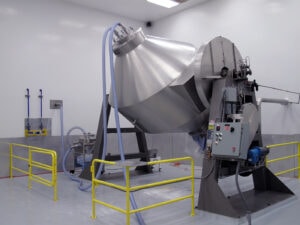
Specializing in the design and manufacture of pneumatic systems and support equipment for the conveying, weighing, and batching of dry materials, Vac-U-Max has a unique adaptation of vacuum transfer called direct charge blender loading, designed specifically for the direct charge loading of blenders, mixers, reactors, and any vessel capable of withstanding a vacuum.
With a facility’s blender or mixer as the primary receiver, VAC-U-MAX configures systems specific to each application, providing the power source, filters, controls and adapters.
Power options include vacuum pump packages from 3hp and higher as well as the company’s exclusive venturi power unit available in single to quadruple Venturi versions. Direct charge blender loading systems standardly convey up to 7000 pounds per hour and when they exceed that rate, systems are equipped with increased levels of automation.
“Our system is equipped with a bag dump station and a floor standing blender loader that captures carry-over,” says Muench.
The bag dump station is designed to handle 25-kilogram bags, pails, and cartons. Now, rather than two additional days of labor to transfer product from bags to fiber drums, an operator now slices the entire length of the bag, flips it over and dumps the powder into the station. From the station, powder flows by gravity to the vacuum pick-up point on the bottom of the bag dump station and discharges directly into the blender or formulator.
Vac-U-Max bag dump stations generally include an integral dust collector, however Package Kare chose to utilize its existing dust collector with ducting that connects to the back of the station.
Configuration Options: Floor Standing v Suspended Units
Because Vac-U-Max configures systems specific to each application, direct charge blender loading systems come with the option of either floor standing or suspended blender loaders that are designed to significantly reduce the amount of carry over, eliminating product loss.
The advantage of floor standing units is that they are readily accessible for cleaning and can be equipped with casters, allowing them service more than one blender. With floor standing units, once the blender is loaded and equalized, carry over releases into an airtight vessel that preserves product integrity allowing for reuse or safe disposal.
With suspended units, once the blender is loaded and equalized, material automatically discharges back into the blender eliminating the need to handle product manually.
Results & Feedback

“In our industry there is some concern about carry-over and the goal is to minimize the amount of product you handle manually. I believe the industry standard is about 10 percent carry over, but the Vac-U-Max system is extremely efficient,” says Muench.
“We have three or four main products that we run in our formulator, and after 2.5 hours of loading 2500 pounds we only have about one pound of carry over,” she says. “The most I have seen is two pounds and that is with another product line that we run with 6000 pounds of powder per batch.”
“Their filter systems are incredible. The vacuum pump has not seen an ounce of powder in it,” say Muench.
The minimal carry-over experienced by Package Kare is due in part to the large capacity of its equipment–the larger the blender, mixer or formulator, the less carry over is accumulated.
Sometimes the cost benefit of equipment goes beyond reduced labor, plant efficiency, and reduced material costs—extending to the ability to take on new and varied customers. This was the case for Package Kare, when a new client approached them with a material that appeared impossible to convey pneumatically.
“We would have had to turn a customer away if Vac-U-Max hadn’t found a way to get the finished product to work with the system,” says Muench.
The solution to get the clay-like material to convey into bulk bags included fitting a pick-up hopper into the space where fiber bins normally sat in the Gemcomatic. From the pick-up hopper—equipped with a free-flowing screw discharger designed to handle sticky powders—material is metered into the conveying line to a vacuum receiver, discharging into a bulk bag loading station and then releasing into a fresh bulk bag.
“They gave us something that would already fit our device. It was easy—just plug it in and go,” says Muench.
“We deal with a lot of difficult materials, and working with Vac-U-Max has allowed us to meet customer needs without having to modify our equipment,” she says. “When you start getting into equipment modifications, it means bigger and bigger dollars.”
Additional Benefits
In addition to eliminating retrofitting costs and reducing labor needed to accommodate the sacks and bulk bags, the company has also benefited from reduced labor costs associated with standard maintenance and cleaning because of the conveyor system’s simple design.
At the toll blending facility, there are three tiers of employees on the floor—helpers, operators and mechanics. “The operation of the conveying equipment is so simple, an operator level employee is not necessary. Our helpers set up and load or unload the equipment. The conveying system doesn’t need any tools to take it apart so there is no need for mechanics to operate this system,” says Muench.
To ensure the equipment is free of residual powder, equipment is taken apart and cleaned after every product. “We have different hoses for every product and that saves a lot of time. It only takes 30-45 minutes to wash down the equipment and change out the bags, filters and hoses,” she says.
Muench says, “the process has eliminated the 16-hour repack procedure, allowed us to accept all three standard means of carrying bulk material, and saved us cost and resources.”
The use of direct charge blender loading systems allows processors to adapt to industry changes by eliminating the need for conventional vacuum receivers, transferring all materials into the process without spills and waste, and keeping housekeeping to a minimum.
Image gallery
Food Producer Uses Pneumatic Conveying System to Handle 20 Tons of Baker’s-Like Flour
Case Study
New system increases safety, efficiency, and energy savings.
When Brian Miller, Plant Engineer for Mrs. Miller’s Homemade Noodles Ltd., which produces 40,000 pounds of noodles per week, switched from handling 50-pound bags of flour to handling 2000-pound bulk bags, he knew he would need to integrate a new conveying system into his process.

The former conveyor—an older pressure-based system which transported the flour from a hopper through a volumetric feeder and finally to a mixer—would no longer satisfy the company’s needs.
Mrs. Miller’s Homemade Noodles Ltd. is located in the middle of an Amish community in Fredericksburg, Ohio. This family-owned and operated business has been dedicated to producing preservative-free, homemade-quality products with the best ingredients since 1973.
Project Goal
Miller’s goal was to implement a system that would efficiently convey 20 tons of very fine flour per week, and eliminate the need for manual filling. “The flour we use is like bakers flour and it is difficult to convey,” says Miller. “It sticks to a lot of surfaces and if you have leaks in your system you get a lot of dust.”
After some research, Miller found he could achieve this goal with a pneumatic conveying system from Vac-U-Max, a pioneer in vacuum solutions since 1954, and one of the few suppliers who routinely designs and builds custom and semi-custom pneumatic conveying systems and support equipment for conveying, batching and weighing dry materials.
The Solution
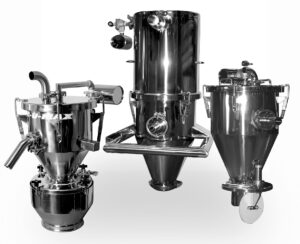
While fine powders may pose conveying issues for some manufacturers, Vac-U-Max has tested thousands of difficult-to-convey materials and is an expert in material characteristics. They are fully equipped to meet customer demands. One way Vac-U-Max handles problems with fine powders is by applying a high polish finish to the systems’ interior and exterior, reducing the amount of powder sticking to the system.
Since the inherent nature of the pneumatic system prevents loose powder from becoming airborne, it makes for a cleaner and safer environment all around. Miller says, “the system is completely enclosed. It’s been very good that way. No mess.”
Outcome and Benefits
Although the system has reduced some housekeeping time, Miller, who is committed to continually evaluating and improving safety in their plant, says, “the bulk of the gain is safety and efficiency.”
“The new system is safer because it accommodates the super sacks better, and feeds the product directly from bags without manual labor,” he explains. “Before, our guys were climbing up to a big hopper and would fill it by hand sometimes. Just more dangerous.”
In addition, to increasing safety and efficiency in the plant, Miller also likes that the new system is more compact, saves energy and reduces noise in the plant.
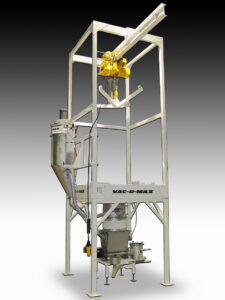
“Space is always at a premium at any plant facility,” says Miller. “The Vac-U-Max is more compact and allowed us to eliminate that big hopper,” which is something that Miller has found to be of great benefit.
In addition to the systems having a smaller footprint, the systems have fewer moving parts because they work on compressed air instead of electricity.
“We used to have a couple of electric motors running in the process, but now there are none,” says Miller. Beyond reducing the noise by eliminating the motors, Miller is confident the unit reduces energy costs.
One of his main concerns regarding the compressed air was the flow rate required by the system. “We move about one cubic foot per conveying cycle and I didn’t want to overwork the compressed air system, but it has not been a problem—it has worked very well,” he says.
The conveyor manufacturer is also one of the top rated companies when it comes to customer service and Miller can attest to this by his experience of working with the manufacturer to solve the only issue he had while implementing the conveying system.
“Our bulk bags are a little oddly sized, and the new rack didn’t fit them,” he explains. “I told my contact about the problem and that very day he got an engineer on the phone who said, ‘We’ll build you a new one.’ In less than a week, a new rack arrived at the facility that was custom designed for the bags. Very impressive service.”
Overall, Miller says, “the Vac-U-Max system runs more efficiently than the other system did, is quieter, and doesn’t take as much space because we could eliminate the big hopper, and it is safer.”