

Vacuum Conveying for Continuous Pharmaceutical Manufacturing
Article
What are the regulatory implications of adopting vacuum conveying technology in pharmaceutical production?
In its draft Guidance Quality Considerations for Continuous Manufacturing: Guidance for Industry, the FDA stated that “adopting continuous manufacturing for pharmaceutical production will reduce drug product quality issues, lower manufacturing costs, and improve the availability of quality medicines to patients [1].” The widespread use and demonstrated success of vacuum conveying systems in many other industries that employ continuous manufacturing methods may have contributed to these expectations.

The Guidance defines continuous manufacturing (CM), as “an integrated process that consists of a series of two or more unit operations (the system) [2].” In such a process, “the input material(s) are continuously fed into and transformed within the process, and the processed output materials are continuously removed from the system [2].”
The definition of continuous systems in the Guidance also distinguishes between an end-to-end approach, where “the drug substance and the drug product process steps are fully integrated into a single continuous process and there is no isolated drug substance or intermediate,” and a hybrid approach where a “combination of batch and continuous process steps are used for drug substance or drug product manufacture [2].”
Vacuum conveying systems
A standard vacuum conveying system consists of five pieces of equipment that work as one: a pickup point, conveying line tubing, a vacuum receiver, a vacuum producer, and a control module.
The most basic vacuum conveying system is a timed system, consisting of two basic cycles: a conveying cycle and a discharge cycle. The control panel, which often works in concert with some type of level control, dictates the amount of time that the system conveys material to the vacuum receiver and then how long the discharge valves are open to drop the material into other equipment or intermediate vessels.
Vacuum conveying lines can be routed between floors, through partitions, and around machinery and can easily accommodate process modifications through rerouting.
Hybrid approach
Hybrid CM systems are often pre-engineered to be integrated with a specific unit operation, such as blending, mixing, tablet compression, capsule filling, or packaging. This makes the material handling continuous within a specific unit operation, but the unit operations themselves are still separate. Turnkey pre-engineered packages offer an affordable path to eliminate open handling and manual operations that can release fugitive dust into the environment. Fugitive dusts can negatively affect workers’ health, contaminate product, and pose combustible dust hazards.
End-to-end approach
In end-to-end CM, vacuum conveying equipment facilitates integration between unit operations, removing materials from one operation and feeding them to the next, using modern computerized technology with pneumatic design.
A fully customized vacuum conveying system completely integrates the system, where the discharge point from one unit becomes the pick-up point for the next. These types of sophisticated systems, which include multi-ingredient handling systems, are custom engineered to suit customers’ unique manufacturing processes.
FDA approval
Recognizing that manual material handling can have negative effects on drug product quality, the FDA redefined the types of manufacturing changes that need supplemental FDA approval, making it easier for drug manufacturers to adopt newer, automated technologies by simply requiring changes to be documented in annual reports. Appendix A of CMC Post-Approval Manufacturing Changes to be Documented in Annual Reports asserts that a “decrease in the number of open handling steps or manual operation procedures, when it reduces risk to product and there is no other change to the process [3]…” has “a minimal potential to have an adverse effect on product quality [4].”
The same ideal also appears in Scale Up and Post Approval Changes (SUPAC)-IR, indicating that, “(a) change from nonautomated or nonmechanical equipment to automated or mechanical equipment to move ingredients [5],” is a Level 1 change “unlikely to have any detectable impact on formulation quality and performance [6].”
These changes make it easier for drug manufacturers to automate processes with ready-to-operate pre-engineered vacuum conveyors for pharmaceutical applications such as softgel and capsule conveyors, tablet press loading conveyors, and direct-charge blender loading.
Whether you require a fully automated, customized system for CM or a general-duty or application-specific pre-engineered system, an experienced and knowledgeable vacuum conveying system supplier can help ensure that your equipment design aligns with FDA guidelines for pharmaceutical manufacture.
References
- FDA draft Guidance. Quality Considerations for Continuous Manufacturing February 2019: Background, page 2.
- FDA draft Guidance, Quality Considerations for Continuous Manufacturing February 2019: Definition of continuous manufacturing, page 22.
- FDA Guidance, CMC Post-Approval Manufacturing Changes to be Documented in Annual Reports: Appendix A, section 3.6, page 9.
- FDA Guidance, CMC Post-Approval Manufacturing Changes to be Documented in Annual Reports: Discussion, page 3.
- FDA Guidance, Scale Up and Post Approval Changes (SUPAC)-IR: Immediate Release Solid Oral Dosage Forms Scale-Up and Postapproval Changes: Chemistry, Manufacturing, and Controls, In Vitro Dissolution Testing, and In Vivo Bioequivalence Documentation Manufacturing: Equipment, Level 1 Changes, Definition of Change, page 18.
- FDA Guidance, Scale Up and Post Approval Changes (SUPAC)-IR: Immediate Release Solid Oral Dosage Forms Scale-Up and Postapproval Changes: Chemistry, Manufacturing, and Controls, In Vitro Dissolution Testing, and In Vivo Bioequivalence Documentation Manufacturing: Equipment, Level 1 Changes, Definition of Change, page 6.
Image gallery
Supply Meets Demand with Continuous Powder Processing System
Case Study
Global GMP Manufacturer of Pharmaceutical Ingredients and Excipients Maximizes Powder Handling, Process Efficiency, and Plant Safety to Keep Up with Demand
With two GMP facilities located in Montreal, Canada, A&C Your Global GMP Partner (now Actylis) manufacture, pack and distribute bioprocessing liquid and bulk materials under Good Manufacturing Practices (GMP) with full compliance to all international regulatory requirements. GMP ensures that products are consistently produced and controlled according to quality standards. It is designed to minimize the risks involved in any pharmaceutical production that cannot be eliminated through testing the final product. [1]

With product demand increasing A&C realized the need for significant investment in bulk material handling capabilities to support expanding business and increased production, while focusing on minimal downtime. As part of this initiative, A&C continually focused not only on process, but also on end-product quality, safety and compliance.
“A major challenge our customers face is the way bulk materials are supplied to the market. We needed a material handling system that would keep up with our demand, ensure worker safety and limit manual manipulation of material. The VAC-U-MAX team designed and manufactured a material handling system capable of conveying over four and half million pounds of powders per year that now allows us to continually meet our growing business,” said Damien O’Rourke, Vice President & Chief Operating Officer at A&C.
A&C promotes a leadership position in providing full transparency in the supply chain, as demonstrated through EXCiPACT, GMP & GDP certifications. EXCiPACT is a non-profit organization that owns and manages oversight of an independent, high quality, third party certification available to pharmaceutical excipient manufacturers and distributors worldwide. [2]
“A&C’s quality management system is based on providing the highest quality product to companies worldwide while safeguarding public health,” said O’Rourke. “We place strong focus on plant and personnel safety, product lead times, minimizing product contact and manual manipulation of product in support of GMP initiatives.”

Andy Pizans, Canadian Sales Manager for VAC-U-MAX, confirms: “This was a coordinated effort between A&C and VAC-U-MAX. Without this level of cooperation, the project would never have achieved the objectives of supplying a system that was easy to operate, safe, GMP compliant and efficient. All this was accomplished within a tight delivery schedule. A tremendous effort by both companies.”
Among A&C’s service offerings, the powders processed are supplied in custom packaging meeting customer specific requirements. Product must be conveyed from different containers to the discharge point at a rate of 2,200lb per hour. Manual handling of product poses its own set of challenges including slip and fall hazards, fugitive combustible dusts and other sanitary issues that may result in decreased production and lengthy downtime.
Employing vacuum conveying technology for dust containment, labor savings, cleanliness, or safety and environmental reasons lies in the ability of vacuum conveying experts to understand powder characteristics and how those characteristics interact with equipment design. A&C also wanted the best ergonomics for their employees, so they also selected a VAC-U-MAX LoadLifter for the repetitive action of lifting bags from a pallet and depositing it on the bag-opening grate of the bag dump station.
Material Properties & Conveying Behavior
As most pharmaceutical and nutraceutical processes start with a powder or granular material, material characteristics must first be defined with focus on the materials attrition and segregation, vacuum conveying behavior, flow properties, and particle properties like shape, size, cohesiveness, and bulk density. The bulk density of a material is one of the first indicators of design in terms of sizing various system components such as vacuum receivers and air sources. Bulk density helps determine how many cubic feet per minute (CFM) of air is needed to move the material through the convey line. In A&C’s case, the bulk densities were on the heavy side at 95 and 133 lb/ft3.
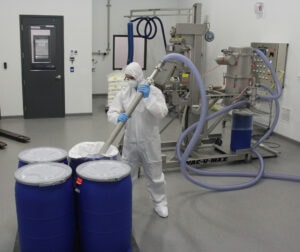
Attention is given to the prospect of segregation especially during manual transfer of materials in drums or other containers, to the next process vessel in the production process. Vibration caused by moving containers promotes segregation. While each application requires a unique resolution based on distinctive environments and equipment, systems are generally built using standard components and customized according to the application requirements. A&C’s process requires the convey and discharge of multiple materials, from diverse types of packaging (bags, bulk bags and drums), in a clean room environment which is subject to washdown sanitation.
Introduction to the Process
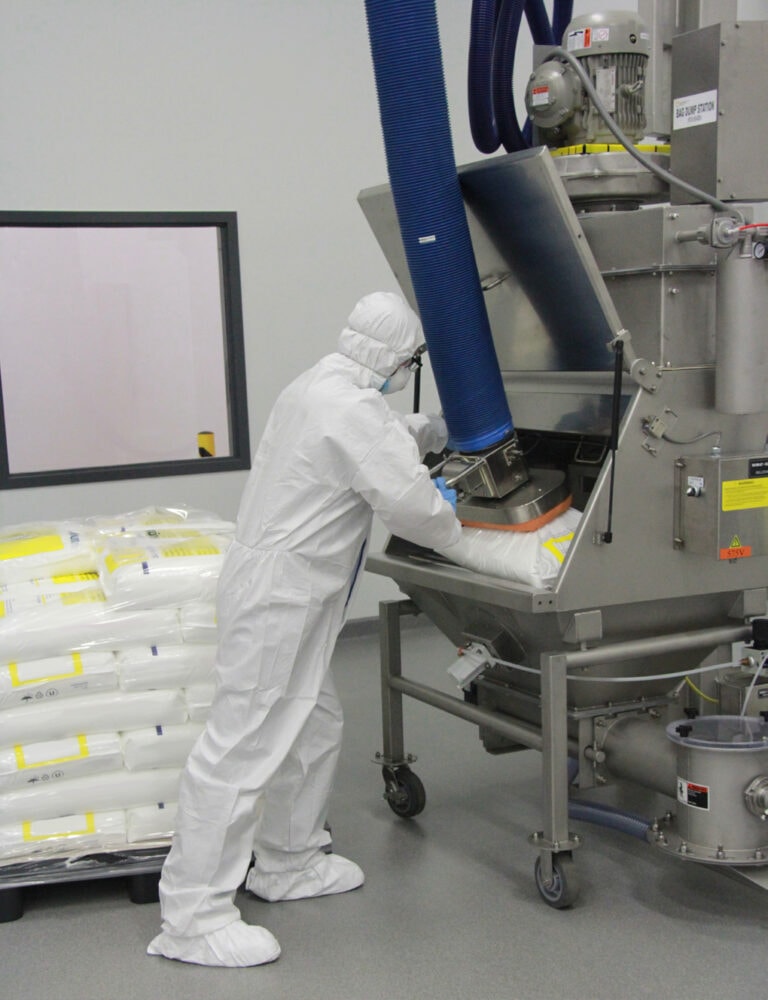
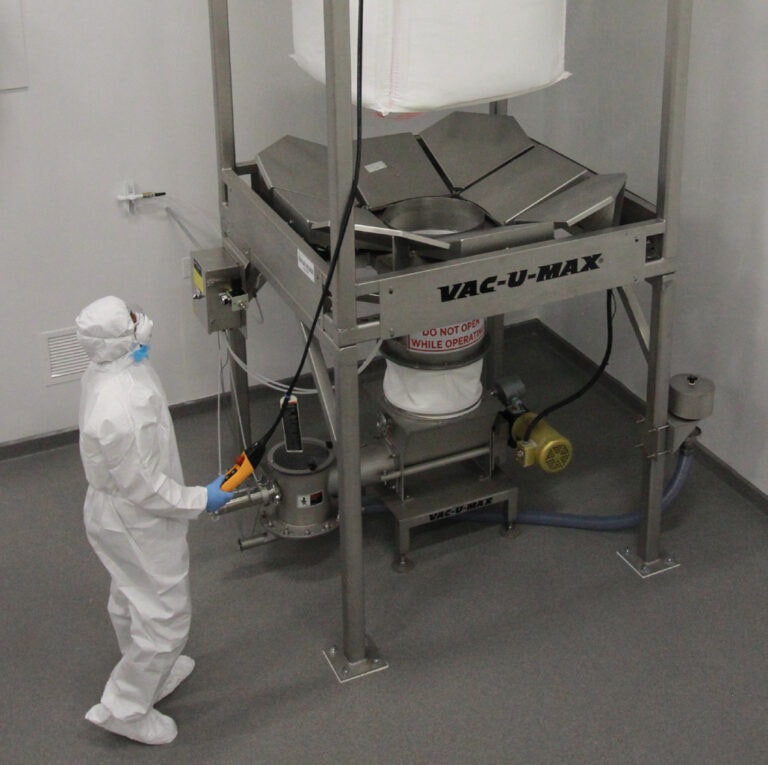
Equally important is the introduction of material to the process (i.e., the pickup point). Product can be introduced via simple suction wand (from a drum), or a sanitary bag dump station with integral dust hood or via bulk bag (a.k.a. super sac) unloading systems. A&C introduces product to the process via VAC-U-MAX’s sanitary Bag Dump Station and the Activator™ Bulk Bag Unloading System with “Chisel Bottom” Screw Dischargers. The Bulk Bag Unload System features a dust-tight cover and cantilevered open flight 6-inch (150mm) auger to provide a consistent, controlled flow of powder into the convey line.
The Activator version Bulk Bag Unloader features four pneumatically operated actuator petals to massage the lower portion of the bag in an alternating-side pattern to promote optimal material flow toward the center of the bag. “We have tested two-sided actuators, but the four-petal design is far more effective in promoting material flow to the bag outlet,” states Doan Pendleton, Vice President of VAC-U-MAX.
The Activator assembly includes a NEMA 4X control panel and level control so that the bag is only massaged when powder is needed. The bag access door is capped for dust collection during bulk bag discharge. The Activator uses lubrication-free pneumatic lifters that consume 50% less compressed air than air-cylinders, providing A&C with lower operating costs.
A&C can minimize material handling devices such as forklifts in the work area by leaving the bulk bag on a pallet, lifting and placing it into the bulk bag unloader with its integral I-Beam and 2HP hoist. The operator controls the hoist from a remote pendant, taking them safely away from the lifting zone. The “I” beam and Bag Lift Frame are constructed in 304L stainless steel and handle bags up to 48-inches (122cm) high with weights up to 2250 lbs (1020kg), with typical I-beam and hoist rated for up to 4,000lbs (1800kg).
The unloader is equipped with a manual iris valve in the bag access housing which allows the operator to untie a full bulk bag discharge spout without any release of product. All product contact surfaces are designed in 316 stainless steel including the sealing collar, operator housing with access door, conical pickup adapter and screw discharge devices. The entire bulk bag unloader is constructed in stainless steel to meet A&C’s GMP program.
The sanitary 316 stainless steel VAC-U-MAX Bag Dump Station is equipped with an integral dust collector that automatically turns on when the dump station door is opened, to keep dust from the bag opening away from the operator. Dust that is collected on the static-conductive filters is pulsed automatically into the bottom of the dump station so that no material is lost. The materials have high bulk densities, so the bag dump station has the same screw discharger on the bottom to provide a metered feed of material into the convey line. Like the Activator Bulk Bag Unloader, the screw discharger has a pneumatic poppet valve on its outlet to prevent any dribbling of powder into the convey line which might affect the accuracy of the conveying process.
Observing Distances
Bulk density, while one of the most important factors in sizing a system, is not the sole criterion used to determine components. Another key factor in sizing and determining the type of system needed is the distance that the material is traveling. In pneumatic conveying, the more tubing incorporated into the bulk material handling system, or the further the conveying distance, results in larger vacuum pumps since it takes more airflow to pull (or push) the air through the tube.
Vacuum conveying systems move product vertically and calculated the same as moving product horizontally–in linear feet. However, each 90 degree sweep in the system equals 20 linear feet; thus, moving material horizontally 110 feet (34m) and vertically 110 feet (34m) with four 90-degree sweeps results in an overall conveying distance of 300 feet (91m). Vacuum conveying technology was selected by A&C because any leaks in the system will be inward and mitigates the risk of appositive-pressure system that develops a leak results in a cloud, or pile, or powder in the work environment. This not only reduces exposure for the operators, but also aids in reducing combustible dust, sanitation and product yield issues.
In addition to factoring how many vertical rises and horizontal runs, the bulk material handling system factors in the number of equipment connections, headroom requirements for vacuum receiver mounts, and any containment or clean room requirements, as required by A&C. By reducing the number of overall process steps, processors reduce the potential for product segregation resulting in better quality control, smaller equipment, simplified 1:1 scale-up, and shorter production time – while reducing labor and maintenance costs.
The Heart of the System
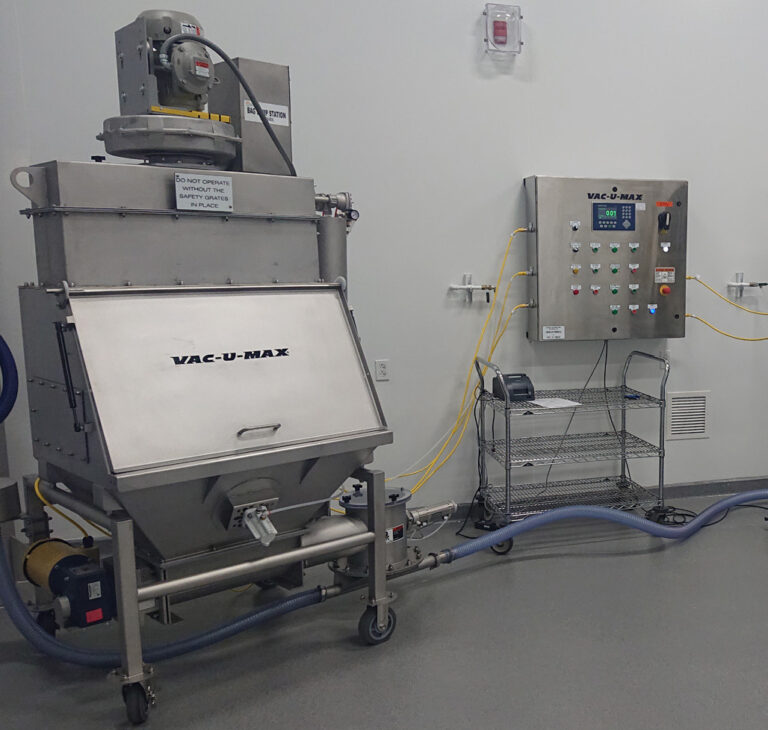
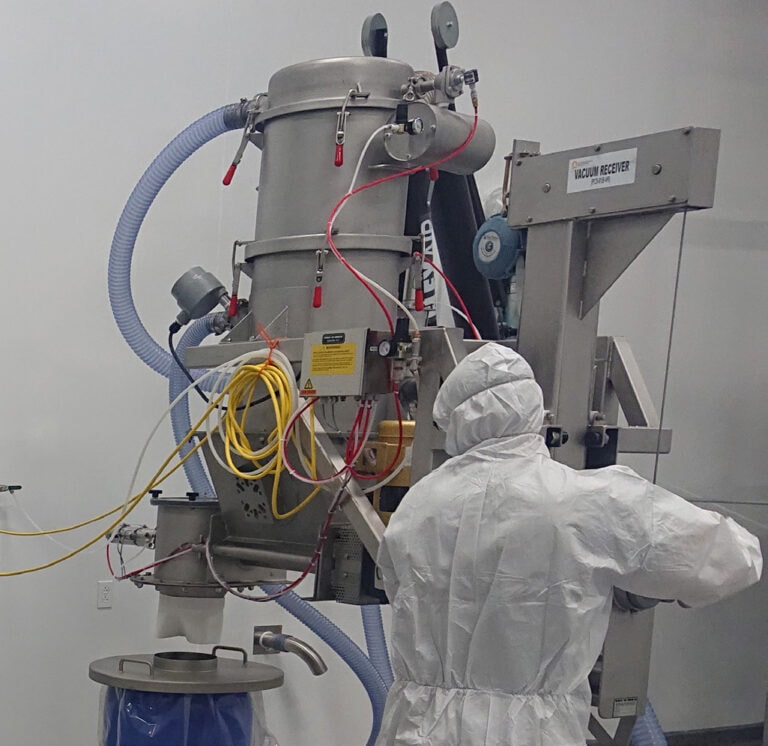
Self-sufficient and the heart of the process, the sanitary pharma-grade VAC-U-MAX Vacuum Conveyor is mounted on a rolling lift frame to allow A&C to remove the equipment from the production room for cleaning. The lifting frame allows the conveyor to be raised into operating position above the drum on a scale, and to lower it to a travel position which is also a convenient height that encourages good maintenance and sanitation of the equipment.
The unique VAC-U-MAX vacuum conveyor is integrated into a screw discharger to eliminate conical hoppers and discharge valves. All product contact parts are designed in 316L stainless steel per 3A Sanitary and USDA design standards. A pneumatic poppet valve on the end of the screw discharger prevents any chance of dribble feed from the receiver into the conveying line. A gas pulse is sent to the receiver’s filter to release any entrained material that may have accumulated on the filter during conveying.
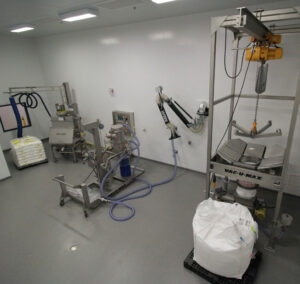
A good vacuum conveyor needs a good vacuum producer. The vacuum producer selected for A&C’s system is a continuous-duty 5HP regen blower unit due to its good vacuum production and airflow, compact size, direct-driven impeller and low noise level—perfect for a pharmaceutical environment.
If the vacuum conveyor is the heart of the system, the controls must be the brains of the operation. VAC-U-MAX has been selling equipment in Canada for decades and was able to provide A&C with a C-UL-labelled main control panel in compliance with Canadian electrical standards. “This is a great benefit for my customers in Quebec,” states John Hamilton of Hamilton Process Systems Inc; the VAC-U-MAX representative for the province for over 16 years.
VAC-U-MAX is a UL- and C-UL certified control panel builder for general purpose and explosion-hazard environments. The control panel at A&C incorporates all electrical and pneumatic functions from the bulk bag unloader, bag dump station, vacuum conveyor, (3) screw dischargers and a platform scale. The remote devices are plugged into the main control panel with quick disconnect plugs that can be disconnected and capped before washdown.
The vacuum transfer principle is used as a continuous refill device for continuous operation. Pneumatic receivers use negative pressure to draw material required for refill into the vacuum receiver which is filled to a pre-determined level, with receiver holding a charge of material until the process below requests a refill. The level of material in the vacuum receiver is determined by level sensors. When the process requires a refill, the discharge valve opens, discharging material to the process below – keeping material moving from source to process.
Vacuum receivers are designed crevice free and are easily cleaned. Systems are very simple to operate, with easy-to-use pick up devices. There are minimal moving parts in contact with product.
Maintaining Momentum
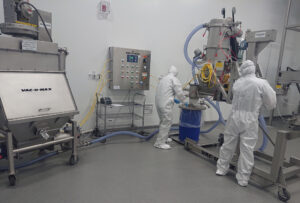
Now, more than ever, pharmaceutical and nutraceutical manufacturers are enhancing production capabilities by implementing vacuum technology to deliver drugs to consumers faster, safer and more economically. When determining the optimal refill method for your processing or packaging equipment, look at refill device response time which should be quick and fast. It is also important to review the overall space and height limitations. Eliminate segregation concerns and evaluate overall cleanability of the refill device.
Vacuum technology provides safer transfer of bulk dry materials, delivering solutions to tight industry standards for sanitation and environmental safety. When pharmaceutical supply chain companies work with expert vacuum conveying manufacturers to design equipment that will perform well with existing equipment and specific processes, they are accessing not only industry specific know-how, but expertise in powder characteristics that transfer from industry to industry assuring processors, through written guarantees, that the equipment will perform the way it is supposed to.
References
1. ISPE. https://ispe.org/initiatives/regulatory-resources/gmp GMP Resources. International Society of Pharmaceutical Engineering.
2. EXCiPACT. https://www.excipact.org/ What is EXCiPACT? International Pharmaceutical Excipients Certification
Image gallery
Exploring Vacuum Technology in Pharmaceutical Processing
White Paper
FDA Eases the Way for Processors to Automate Processing Lines with Safer, Faster and Adaptable Vacuum Transfer Equipment
Pharmaceutical manufacturers are implementing vacuum conveying technologies to deliver drugs to consumers faster, safer and more economically. Vacuum technology provides safer transfer of dry bulk materials and allows pharmaceutical processors to meet tight industry standards for sanitation and environmental safety.
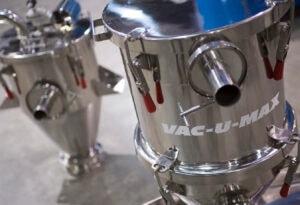
The increasing use of vacuum conveying systems, is due in part, from FDA guidance and clarifications that allow pharmaceutical manufacturers to implement new production technologies by documenting them in annual reports rather than filing for post-approval manufacturing changes in time-consuming supplements.
The FDA clearly indicates that automated material transfer systems are the preferred method for delivering dry bulk powders and solids in pharmaceutical environments and that methods such as use of vacuum conveying are unlikely to have an adverse effect on drug product quality. Adding productivity-enhancing material handling equipment, such as vacuum conveying systems, is a level one change that is eligible for submission in annual reports.
Appendix A in the Guidance CMC Post-approval Manufacturing Changes to Be Documented in Annual Reports states that a “decrease in the number of open-handling steps or manual-operation procedures,” has “minimal potential to have an adverse effect on product quality.”
That statement correlates with the assertion in the Guidance Immediate Release Solid Oral Dosage Forms: Scale-Up and Post-approval Changes: Chemistry, Manufacturing, and Controls, In Vitro Dissolution Testing, and In Vivo Bioequivalence Documentation that “change(s) from non-automated or non-mechanical equipment to automated or mechanical equipment to move ingredients,” are “are unlikely to have any detectable impact on formulation quality and performance. [2]”
Although the Guidances opened the door for change, some confusion still existed about how vacuum conveying systems that operate in semi-continuous and continuous modes, coincided with batch processing as well as where that process fit into reporting changes. The term continuous brought about serious debate about its true meaning because the idea that continuous operation was most often associated with a mode of manufacturing. In some instances, it means 24 hour per day, 7 days per week operation, while in other industries it refers to the mode of manufacturing.
Although this opened the door for pharmaceutical companies to make changes that increased production or protected product and employees, some confusion still existed about how vacuum conveying operating in semi-continuous and continuous modes coincided with batch processing, as well as where that process fit into reporting changes.
To move away from the definition of batch being tied to a mode of manufacturing, the FDA changed the definition in CFR Title 21 210.3(b)(2) to read: “CFR (2): Batch means a specific quantity of a drug or other material that is intended to have uniform character and quality, within specified limits, and is produced according to a single manufacturing order during the same cycle of manufacture. [3]”
The process can be continuous or semi-continuous depending on the level of automation employed. Vacuum transfer is the heart of continuous processes that move dry bulk materials from one processing machine to the next, including mixers, reactors, hammer mills, tablet presses, gel caps, and packaging machinery.
While it’s possible to automate drug manufacturing completely, manufacturers, in lieu of complete infrastructure overhauls, are investing in vacuum conveyors, which are more accurate, cleaner, and safer and cost less than manual handling methods. Vacuum conveyors can fit into existing processes through the routing of conveying lines between floors, through partitions, and around machinery, and they are easily re-routed to accommodate process modifications.
Whether you employ vacuum technology for dust containment, labor savings, cleanliness, or safety and environmental reasons, your success in adding that technology lies in an understanding of powder’s characteristics, including how those characteristics interact with your equipment’s design and your specific processes.
Experts can provide access not only to industry-specific know-how but also to expertise in powder’s characteristics that transfers from industry to industry, and can assure you, through written guarantees, that your equipment will perform the way it should.
Mass flow and Material Separation
The pharmaceutical industry has given a great deal of attention to segregation, especially as it applies to manual transfer of materials in drums or other containers during production. Vibrations, caused by moving containers, promote segregation and threaten quality of batches. Therefore, companies have sought mass-flow methods that move particles at the same velocity, minimizing segregation.
Vacuum conveyors, with virtually no moving parts, use mass flow for the most part. They generally use standard components, but some manufacturers offer fabricating services to customize systems and provide unique solutions for distinctive environments and equipment.
Dust Containment
Dust containment is a principal reason that manufacturers add vacuum conveyors to production lines. Manually dumping feeders creates small dust clouds with each scoop, creating fugitive dust— particulate matter (PM) that is any solid or liquid suspended in the air through wind or human interaction. While half of fugitive dusts are larger than 10 microns—a human hair is 70 microns—and settle on surfaces rather quickly, the other half are smaller—not visible to the naked eye—and can remain suspended in the air for days or weeks.
Fully enclosed systems protect drug product from air, dirt, and waste. As air moves through the system, it cycles through filters before being exhausted. Because materials don’t escape, vacuum conveyors prevent particulates from entering the environment, where they can endanger workers’ health; settle on equipment and surfaces, causing cross-contamination from dislodged fugitive dust; or create explosion hazards.
For ingredients that require higher levels of containment to protect workers’ health, minimizing exposure requires additional scrutiny in conveyor design. One method that offers some additional guarantee of safety for exhaust air is HEPA filtration.
Safety Hazards and Ergonomics
Automatically feeding materials into and removing them from hammer mills, mixers, reactors, and other equipment has multiple advantages beyond dust containment, such as reducing the amount of manpower needed to feed a hammer mill and eliminating safety hazards.
Generally, most processing equipment stands taller than workers do, requiring the addition of ladders or stairs to access feeders and often warranting a second worker for safety. Automated or semi-automated systems eliminate the need for workers to climb stairs or haul heavy containers of material away, alleviating fall hazards. They also are cost-effective because only one operator needs to monitor the equipment’s functioning.
Automatic feeding also eradicates ergonomic issues that can occur with repetitive motion, lifting, and climbing to dump materials manually into feeders. If a manufacturer is paying $250,000 a year in disability suits from manual-transfer injuries, investing in a vacuum conveyor can produce a near-instant return on investment, depending on the level of automation added.

Employing automated, or semi-automated, pneumatic conveying systems to deliver product to and from process equipment including hammermills and screeners eliminates the need for workers to climb stairs or haul heavy containers of material away from the hammermill, alleviating fall hazards and repetitive motion injuries.
Direct Charge Blender Loading
Blenders, mixers, and reactors are common types of equipment used in pharmaceutical manufacturing and often require a mezzanine level for manual loading or specialized equipment like drum loaders or vacuum conveyors.
Although better than manual loading, drum loaders have limitations, such as allowing operators to load only one drum at a time, which makes the delivery of materials to a blender or reactor time-consuming. In some circumstances, an operator must load multiple ingredients into drums prior to loading blenders and reactors, further slowing the process by increasing manufacturing steps.
Vacuum conveying systems designed specifically for direct charge loading can efficiently load equipment that is capable of withstanding a vacuum. With a blender or mixer as the primary receiver, the conveying manufacturer provides the rest of the system—power source, filters, controls, and adapters.
Configured specifically for each application with standard equipment, such systems offer the option of either floor-standing or suspended blender loaders and can reduce the amount of carry over significantly, eliminating product loss and ensuring batch integrity. During the loading process, carry over is the amount of product collected in the filter separator that separates the air from solids (dust) inside a vessel to prevent solids from reaching the vacuum pump. Standing units are easy to clean, and those units with casters can service more than one blender.
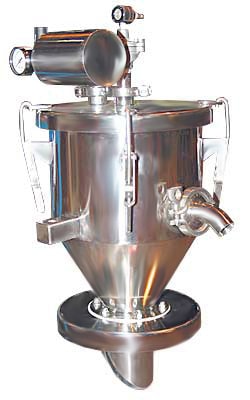
After the blender is loaded via the pneumatic conveyor system and the load equalizes, the carry over automatically releases into an airtight vessel that preserves product integrity, allowing reuse or safe disposal. Suspended units automatically discharge material back into the blender, eliminating the need to handle product manually.
Because such units come apart easily without tools, washing equipment and changing bags, filters, and hoses between batches and drug products takes only 30-45 minutes.
Vacuum Tablet Press Loading Systems
Vacuum tablet press loading systems allow pharmaceutical processors to automate batch process. These turnkey systems mount on customers’ presses and are available for single or dual-hopper tablet presses. The equipment’s construction is USDA accepted.
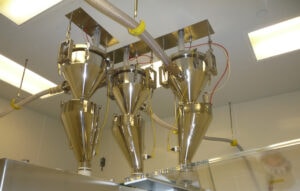
The systems automatically convey tablet granulations from drums or other containers or equipment to surge bins over tablet presses. A tube-hopper material receiver, with vertical sides to minimize material hang-up, lies over each surge bin, and the control panel and vacuum pump reside in an adjacent room. The systems apply a vacuum to all material receivers using one vacuum pump. A full opening discharge valve assures complete discharge of material.
The modern electronic technology of vacuum tablet press loading systems, with mechanical and pneumatic designs and programmable control panels with microprocessors, can be the nerve centers for manufacturing and can provide reserve capacity to handle a total of sixteen presses.
The microprocessor constantly scans level controls on the surge bins and initiates conveying of tablet formulation to the receiver over any press requiring material, insuring that no press runs dry, which could cause costly tooling damage.
Gel Cap Conveying
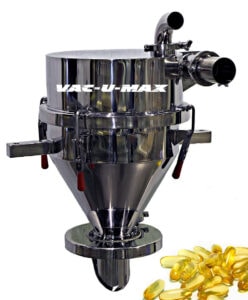
Another type of turnkey conveyor package is the gel cap conveyor that delivers material from inspection machines to packaging lines at a transfer rate of 500 to 1000 pounds per hour (photo). Gel caps, soft gels, or tablets spill from the inspection machine into the hopper and then convey into the vacuum receiver above a packaging or sorting machine.
The manufacture of delicate gel caps is an expensive process, and gel cap conveyors can protect a drug product’s integrity and often also incorporate environmental improvements. For example, gel caps can sound like bullets when hitting the side of a hopper, creating additional noise in a facility. Tangential inlets can eliminate noise and protect delicate drug product from damage.
Collection of Wastes / Wastewater
In addition to providing cleaner, safer, and quieter environments, vacuum technology is also integral to complying with FDA and EPA guidelines, especially in the collection of wastewater.
Wet, central, pharmaceutical vacuum systems can assist manufacturing facilities in complying with regulations that prohibit disposal of liquids containing active pharmaceutical ingredients (APIs) and non-regulated pharmaceuticals and personal care products (PPCPs) into municipal wastewater sewer systems and municipal wastewater treatment plants (WWTP).
Such a system can provide multiple hose connections throughout a facility where wash-down processes occur, and when a network needs to move vertically, special tubing valves are available to prevent water from falling back into the network if the system shuts down.
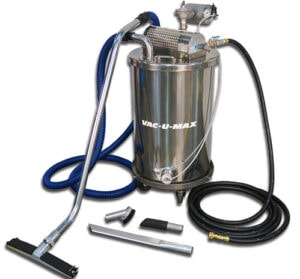
The system can move the liquid generated from a wash-down into a sanitary-tubing network and then collect it in a wet separator. A washable, corrosion-resistant filter media then separates the liquid from the airstream, and an integral pump transfers the solution to an in-house treatment system to address the APIs and PPCPs prior to discharge to the local municipal WWTP.
Depending on the treatment process, the liquid may be suitable for re-use within the pharmaceutical facility via a closed-looped treatment system. Other features of that type of industrial vacuum system include a full control package, liquid level sensors, sanitary construction, and protective secondary containment in the event of a release during maintenance or normal operations.
Vacuum technology is also ideal for preventing solids from being delivered to WWTPs, which can cost processors upward of $10,000 per month in back charges. To keep solids from entering drains, vacuum-technology experts have borrowed techniques from other industries and have applied them to pharmaceutical and food applications to separate materials in the vacuum stream. Constructed of stainless steel, these systems are built to be explosion proof.
Conclusions
Whether employing a central vacuum system to eliminate harmful waste from the wastewater stream or using vacuum conveyors to eliminate hazards, increase the speed at which a processing line operates, or streamline production through automation, working with a manufacturer who has extensive experience in the delivery of powders ensures that pharmaceutical manufacturers get the right equipment for the job.
References
- Guidance for Industry, CMC Post-approval Manufacturing Changes to Be Documented in Annual Reports, Appendix A. https://www.fda.gov/downloads/Drugs/GuidanceComplianceRegulatoryInformation/Guidances/UCM217043.pdf
- Guidance for Industry, Immediate Release Solid Oral Dosage Forms: Scale-Up and Postapproval Changes: Chemistry, Manufacturing, and Controls, In Vitro Dissolution Testing, and In Vivo Bioequivalence Documentation. https://www.fda.gov/downloads/drugs/guidances/ucm070636.pdf
- CFR Title 21 210.3(b)(2) https://www.ecfr.gov/current/title-21/chapter-I/subchapter-C/part-210/section-210.3
Image gallery
Vacuum Conveying System Allows Toll Blender to Adapt to Changing Market
Case Study
Direct charge blender loading eliminates costly equipment modifications.
Often when processors face capital expenditures to adapt to industry changes or increased production demands, they turn to toll processors to help lighten the production and financial load.

When toll processors are confronted with industry changes, however, they have no choice. They have to adapt in order to continue servicing their clients, which is what Package Kare Inc. faced when the bulk powder industry began phasing out the use of fiber drums for transporting and replacing them with more economical paper and bulk bags.
“Our customers started asking if we could handle bags,” says Casey Muench, President of Package Kare Inc. (Advanced Powder Solutions), a premier toll processor specializing in formulating, blending, and surface treating of powders such as titanium dioxide, zinc oxide, and other common industry powders.
Many of the company’s clients rely on the toll manufacturer as an extension of their processing facility since it uses the same exclusive blending and formulating technology they have in their plant. This exclusive technology produces a precise uniform blend needed in the chemical, cosmetic, nutraceutical, personal care, and food and beverage industries.
“Some of our clients that need this technology only do a couple runs of product per year and can’t justify purchasing a new machine,” says Muench.
Although blenders and formulators are typically difficult to load and access, the company utilizes a Gemcomatic that allows it to easily dump drums directly into the blender without product or fugitive dust escaping. Because the company’s primary method to load the blender was with drums, it developed a repack procedure to accommodate bags while it searched for a more efficient solution.
“We manually had to put 8 or so bags into these drums. That increased labor by 16 hours and required us to spend an additional $600 on drums. It also created a lot of dust in the repack room, so we called Vac-U-Max and told them of our dilemma,” she says.
Engineering a Solution
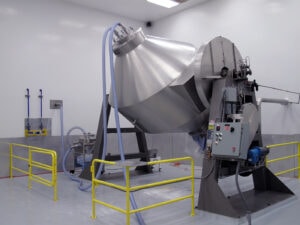
Specializing in the design and manufacture of pneumatic systems and support equipment for the conveying, weighing, and batching of dry materials, Vac-U-Max has a unique adaptation of vacuum transfer called direct charge blender loading, designed specifically for the direct charge loading of blenders, mixers, reactors, and any vessel capable of withstanding a vacuum.
With a facility’s blender or mixer as the primary receiver, VAC-U-MAX configures systems specific to each application, providing the power source, filters, controls and adapters.
Power options include vacuum pump packages from 3hp and higher as well as the company’s exclusive venturi power unit available in single to quadruple Venturi versions. Direct charge blender loading systems standardly convey up to 7000 pounds per hour and when they exceed that rate, systems are equipped with increased levels of automation.
“Our system is equipped with a bag dump station and a floor standing blender loader that captures carry-over,” says Muench.
The bag dump station is designed to handle 25-kilogram bags, pails, and cartons. Now, rather than two additional days of labor to transfer product from bags to fiber drums, an operator now slices the entire length of the bag, flips it over and dumps the powder into the station. From the station, powder flows by gravity to the vacuum pick-up point on the bottom of the bag dump station and discharges directly into the blender or formulator.
Vac-U-Max bag dump stations generally include an integral dust collector, however Package Kare chose to utilize its existing dust collector with ducting that connects to the back of the station.
Configuration Options: Floor Standing v Suspended Units
Because Vac-U-Max configures systems specific to each application, direct charge blender loading systems come with the option of either floor standing or suspended blender loaders that are designed to significantly reduce the amount of carry over, eliminating product loss.
The advantage of floor standing units is that they are readily accessible for cleaning and can be equipped with casters, allowing them service more than one blender. With floor standing units, once the blender is loaded and equalized, carry over releases into an airtight vessel that preserves product integrity allowing for reuse or safe disposal.
With suspended units, once the blender is loaded and equalized, material automatically discharges back into the blender eliminating the need to handle product manually.
Results & Feedback
“In our industry there is some concern about carry-over and the goal is to minimize the amount of product you handle manually. I believe the industry standard is about 10 percent carry over, but the Vac-U-Max system is extremely efficient,” says Muench.
“We have three or four main products that we run in our formulator, and after 2.5 hours of loading 2500 pounds we only have about one pound of carry over,” she says. “The most I have seen is two pounds and that is with another product line that we run with 6000 pounds of powder per batch.”
“Their filter systems are incredible. The vacuum pump has not seen an ounce of powder in it,” say Muench.
The minimal carry-over experienced by Package Kare is due in part to the large capacity of its equipment–the larger the blender, mixer or formulator, the less carry over is accumulated.
Sometimes the cost benefit of equipment goes beyond reduced labor, plant efficiency, and reduced material costs—extending to the ability to take on new and varied customers. This was the case for Package Kare, when a new client approached them with a material that appeared impossible to convey pneumatically.
“We would have had to turn a customer away if Vac-U-Max hadn’t found a way to get the finished product to work with the system,” says Muench.
The solution to get the clay-like material to convey into bulk bags included fitting a pick-up hopper into the space where fiber bins normally sat in the Gemcomatic. From the pick-up hopper—equipped with a free-flowing screw discharger designed to handle sticky powders—material is metered into the conveying line to a vacuum receiver, discharging into a bulk bag loading station and then releasing into a fresh bulk bag.
“They gave us something that would already fit our device. It was easy—just plug it in and go,” says Muench.
“We deal with a lot of difficult materials, and working with Vac-U-Max has allowed us to meet customer needs without having to modify our equipment,” she says. “When you start getting into equipment modifications, it means bigger and bigger dollars.”
Additional Benefits
In addition to eliminating retrofitting costs and reducing labor needed to accommodate the sacks and bulk bags, the company has also benefited from reduced labor costs associated with standard maintenance and cleaning because of the conveyor system’s simple design.
At the toll blending facility, there are three tiers of employees on the floor—helpers, operators and mechanics. “The operation of the conveying equipment is so simple, an operator level employee is not necessary. Our helpers set up and load or unload the equipment. The conveying system doesn’t need any tools to take it apart so there is no need for mechanics to operate this system,” says Muench.
To ensure the equipment is free of residual powder, equipment is taken apart and cleaned after every product. “We have different hoses for every product and that saves a lot of time. It only takes 30-45 minutes to wash down the equipment and change out the bags, filters and hoses,” she says.
Muench says, “the process has eliminated the 16-hour repack procedure, allowed us to accept all three standard means of carrying bulk material, and saved us cost and resources.”
The use of direct charge blender loading systems allows processors to adapt to industry changes by eliminating the need for conventional vacuum receivers, transferring all materials into the process without spills and waste, and keeping housekeeping to a minimum.