The 3R’s Revolutionizing Metal Powder Additive Manufacturing
WHITE PAPER
Transforming 3D Printing with Advanced Vacuum Conveying, Sieving, and Blending Technologies
The 3R’s – REclaim, REclassify, and REcondition, are setting a new benchmark in metal powder additive manufacturing, driving efficiency, sustainability, and innovation in 3D printing processes. By utilizing advanced technologies, this approach ensures optimal reuse of metal powders, reducing waste and supporting eco-friendly practices without compromising on quality.
Industry Challenges: Additive Manufacturing
Preserve valuable material. Protect workers. Speed up your process.

The use of metal powders such as aluminum, nickel, titanium, cobalt, copper, and custom alloy powders have a long history in industrial applications. In recent years, their role in 3D printing, particularly metal Additive Manufacturing (AM), has grown significantly due to its advantages over traditional methods such as machining or casting. This evolution has transformed additive manufacturing into a vital technology with a wide range of applications.
The growing adoption of metal powder-based 3D printing has also resulted in a significant expansion of metal powder inventories, revealing variations in critical metal powder characteristics such as bulk density, fluidity, abrasion resistance, particle shape, particle size, cohesiveness, and reactivity. These variations play a crucial role in influencing the behavior of metal powders within the additive manufacturing AM processes including powder bed fusion and binder jet printing applications.
As the AM industry continues to scale-up and transition from manual batch processing to automated continuous processing, the industry faces challenges associated with non-uniform metal powders and post-process material waste. Leftover metal powder in the build box is frequently discarded, resulting in inefficiencies and increased costs. By developing a deeper understanding of metal powder variations, conveying behaviors, and adopting strategies to recycle unused metal powders from the build-box, the AM industry can effectively tackle its challenges. These efforts optimize performance, maintain process efficiency, and improve end-product quality, while prioritizing safety, productivity, and cost savings.
The Solution: REclaim, REclassify, REcondition.
REclaim: Efficient Recovery of Metal Powders
Implementing vacuum conveying technology into additive manufacturing allows process engineers to convey metal powders to and from the 3D printing process. By conveying material to the 3D printer, manual lifting and messy dumping are eliminated. Material is drawn from the source and vacuum conveyed to the printer in a continuous, contained process.
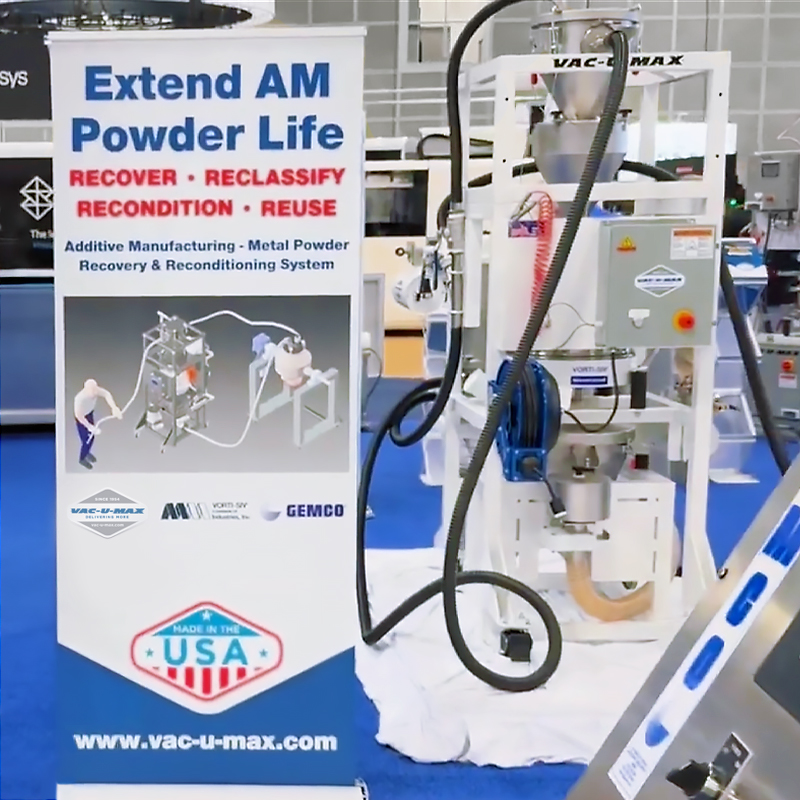
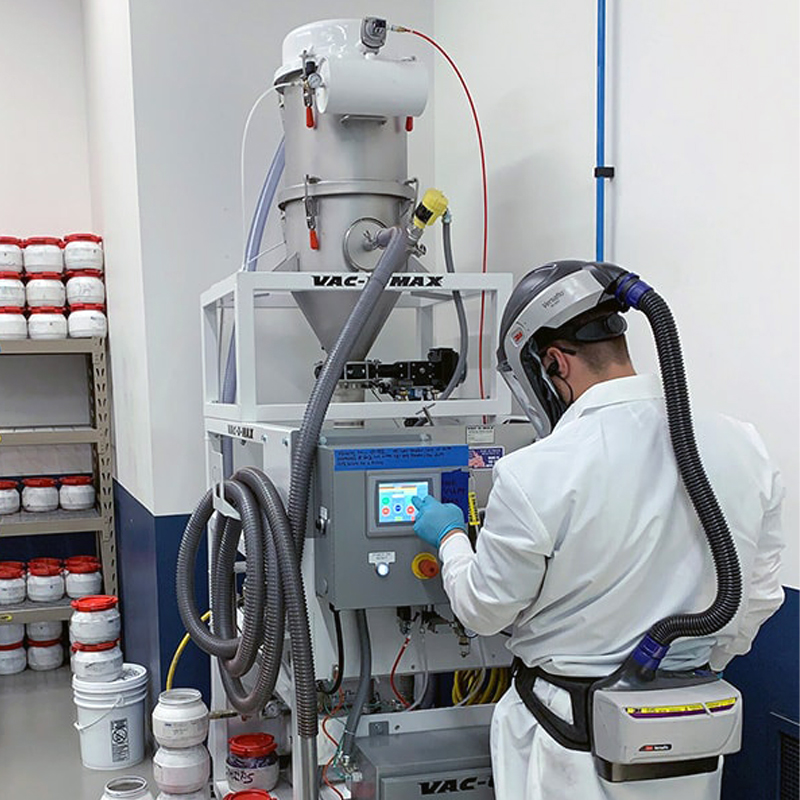
By utilizing innovative vacuum conveyors designed specifically for metal powders, including reactive metal powders that require handling in inert atmospheres, the additive manufacturing – metal powder recovery and reconditioning (AM-MPRR) system safely and efficiently removes unused metal powder from the build box, eliminating the need for manual handling, and significantly reducing the risk of operator exposure to metal powder dust, and potential explosions.
Once the powder is extracted, the system separates the metal powder from the airstream and deposits it directly onto a sieve. The sieve removes oversized agglomerations and foreign debris, with the refined metal powder vacuum conveyed to a tumble blender for further processing, reconditioning, and preparation for reuse.
REclassify: Ensuring Purity and Performance
A critical component of the additive manufacturing metal powder recovery and reconditioning process is the reclassification of the left-over metal powders in the build-box. Reclassification involves the process of sieving or screening these metal particles. Sieving is the mechanical process used to separate particles based on size, ensuring consistency and quality.
The metal powder reclassification step involves placing the metal powder from the build-box onto the sieve. The sieve is equipped with an ultrasonic anti-blinding mechanism, creating vibrations that encourage powder movement. This process helps smaller particles pass through the mesh while larger particles or contaminants remain on top. The mesh size, typically 63 microns, determines the maximum particle size that can pass through the sieve.
The reclassifying process utilizing sieving technology plays a crucial role in maintaining consistent reusable metal powder quality for successful 3D printing though multiple cycles. By implementing advanced sieving technologies, such as ultrasonic sieves, clogging is prevented. One of the primary benefits is the ability to minimize waste.
REcondition: Homogenization and Preparation for Reuse
Reconditioning metal powders is a vital step in the additive manufacturing process, restoring metal powders to their optimal condition for reuse. A highly effective method for this is using tumble blenders, renowned for their ability to improve powder consistency and performance. Once reclaimed and reclassified, the metal powder enters the tumble blender, where it undergoes homogenization, a critical process in ensuring uniformity and quality.
Tumble blenders use a gentle rotating motion to uniformly mix metal powders within a sealed vessel, effectively addressing challenges such as homogeneity, segregation, and surface oxidation. Segregation often occurs during handling, causing particles to separate by size or density, while homogeneity ensures consistent particle distribution for uniform flow behavior. Surface oxidation is mitigated by blending powders with flow agents, reducing oxidization and restoring flowability.
Additionally, residual metal powders from multiple 3D printers can be combined and homogenized into a consistent masterbatch for reuse. Advanced versions of tumble blenders also include drying systems that reduce moisture content to single-digit levels, further enhancing powder flowability. Heat and gas purging can also be integrated into the process to optimize metal powder reconditioning.
The process is automated via direct-charging blender loading. Direct charge blender loading is an efficient and automated method for introducing metal powders into a tumble blender, eliminating the need for manual handling.
In this process, reclaimed or reclassified powders are transferred directly from preceding steps into the blender using a vacuum conveyor. The transfer occurs within a sealed environment, preventing contamination and preserving the quality of sensitive powders such as titanium or aluminum. This method ensures precise, controlled conveying with automated systems that deliver the correct amount of material, maintaining batch consistency.
Direct charge blender loading improves efficiency by reducing downtime and eliminating manual operations, enhances safety by minimizing operator exposure to hazardous powders, and reduces contamination risks by keeping the process enclosed. Additionally, this system can be adapted to handle various types of metal powders, making it an invaluable component of the powder reconditioning process in additive manufacturing.
Operation Overview: How It Works
Maximizing Metal Powder Use & Extending the Lifespan of AM Materials
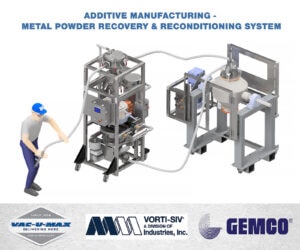
The recovery and reconditioning process begins with the operator vacuuming powder from the build box, where it is collected in a vacuum receiver and separated from the airstream by gravity. Any carryover dust is captured in a small collection container mounted on the opposite side of the frame. The vacuumed powder then passes through a surge hopper and is metered onto the sieve deck, where oversized particles are retained on top of the screen cloth or exit through an optional side outlet.
Reusable metal powder flows through the center-bottom outlet and is collected in a 2 ft³ (57-liter) conical feed bin. To control flow and prevent flooding, a screw discharger at the bottom of the feed bin regulates powder transfer to the vacuum hose, directed to either a blender or dryer. The operator uses two ball valves to redirect suction, enabling powder transfer from the feed bin to the designated equipment until the feed bin is empty.
Any carryover dust is again collected in the small container on the system frame. Once vacuum loading is complete, the operator disconnects the vacuum hoses from the equipment cover, secures them with camlock caps, and reattaches the hoses to a side panel. Proper hose reattachment ensures the blender or dryer can rotate, completing the powder reconditioning cycle efficiently and safely.
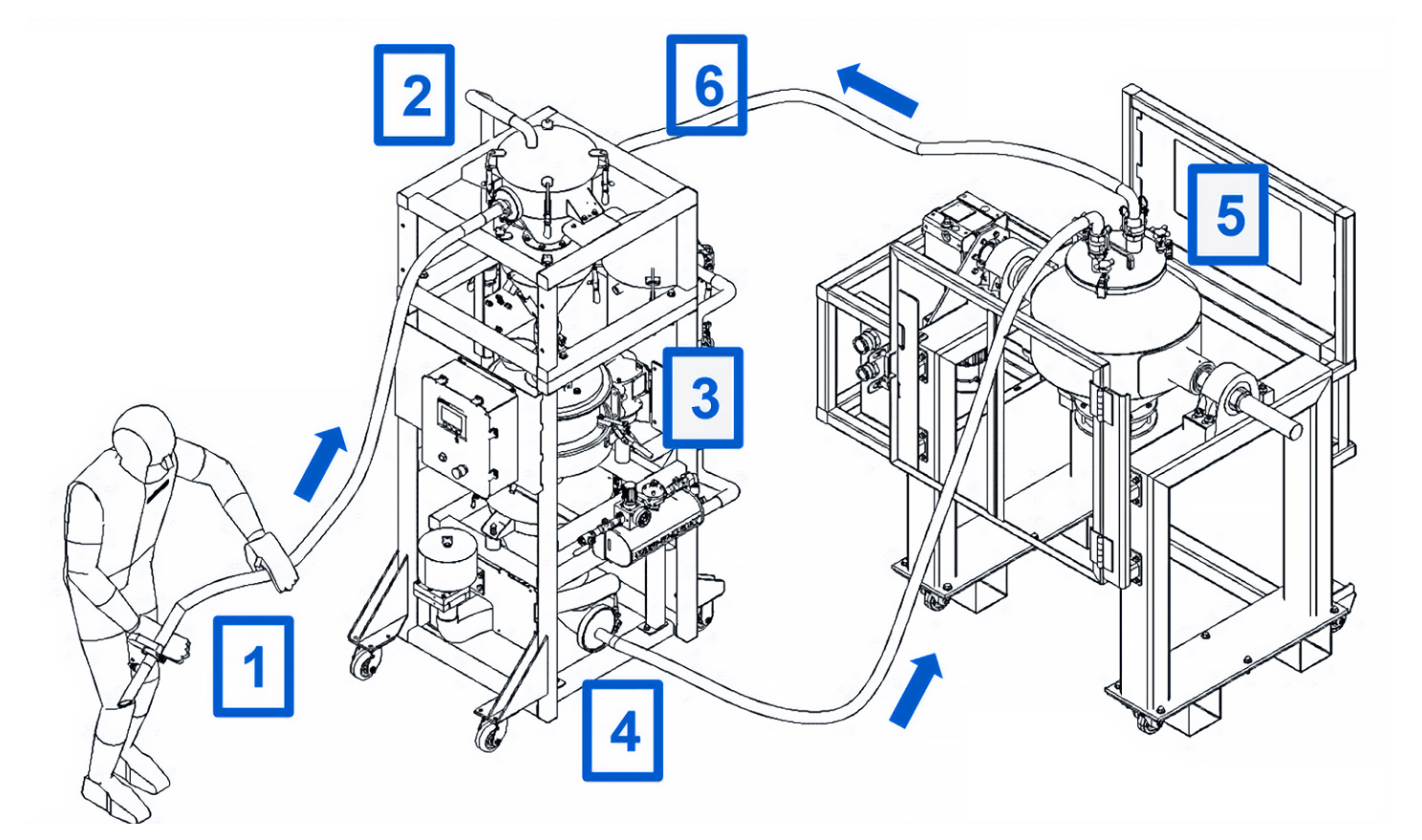
Step 1-2: The operator vacuums metal powder from the build box. The powder is collected with a Vacuum Receiver, which separates it from the airstream via gravity. Any carryover dust is captured in a small collection container located on the opposite of the frame.
Step 2-4: The collected powder is discharged through a surge bin and metered onto the sieve deck. Oversized particles remain on the sieve screen or exit through an optional side outlet, while reusable powder passes through the center-bottom outlet and is stored in a 2 ft³ (57-liter) conical feed bin.
Step 4-5: A screw discharger at the bottom of the feed bin regulates the flow of powder, preventing flooding in the vacuum hose leading to the blender or dryer. The operator adjusts two ball valves to redirect suction from the vacuum receiver to the blender or dryer, initiating powder transfer from the feed bin. Transfer continues until the feed bin is empty.
Step 5-6: As the blender or dryer is loading, any carryover dust is collected in the small collection container on the MPRS frame. Once loading is completed, the operator disconnects that two vacuum hoses from the blender or dryer cover, installs camlock caps, and reattaches the disconnected hoses to the side panel. The blender or dryer will not rotate unless the hoses are properly secured on the side panel.
The Takeaway
Maximize Efficiency, Sustainability, and Safety with the AM-MPRR™
Developed by industry leaders VAC-U-MAX, GEMCO, and VORTI-SIV, the Additive Manufacturing Metal Powder Recovery and Reconditioning (AM-MPRR) System provides a sophisticated, integrated solution to the challenges encountered in powder bed fusion and binder jet printing processes. By utilizing advanced vacuum, sieving, and blending technologies, the system efficiently recovers and reconditions metal powders, ensuring minimal waste and optimal material utilization. This results in significant cost reductions by maximizing material usage and streamlining operational workflows.
The system’s design prioritizes operator ease of use, with automated processes and intuitive controls that reduce manual intervention, enhance efficiency, and minimize the potential for human error. Additionally, safety is a key consideration, with features such as sealed environments, a ground monitoring circuit, and controlled powder handling, minimizing operator exposure to hazardous and/or combustible materials and reducing the risk of contamination. The combination of vacuum removal and sieving processes also reduces downtime, leading to faster print cycles and enhanced process efficiency.
The AM-MPRR system supports sustainability objectives by minimizing waste and promoting resource optimization. Furthermore, it guarantees that reconditioned metal powders consistently meet the stringent quality requirements of high-performance additive manufacturing applications, ensuring reliable results in critical additive manufacturing environments.
Dive Deeper: Meet our solutions.
VAC-U-MAX Metal Powder Recovery Systems: AM-MPRS™ & AM-MPRR™
VAC-U-MAX offers two main systems for metal powder recovery, each of which can be customized for your process. Both options are closed-loop systems, protecting material from contamination, maintaining moisture content, and significantly reducing the risk of operator exposure to dust. Reclaimed powder can be reused immediately, blended with virgin materials, collected for storage, or set aside for recycling.
Our systems feature VAC-U-MAX plug-and-play design and are easily serviced—no tools needed—and their low profile, portable design makes them easy to maneuver around multi-printer facilities. Select a system below to learn more and view full specifications.