

San Juan Seltzer Brews Up Safety During Expansion
Case Study
Hard seltzer producer eliminates ergonomic hazards, meets demand, and simplifies process with a space-saving, sanitary vacuum conveyor.
When San Juan Seltzer launched its first production run in 2018, it became part of the spiked seltzer growth explosion and quickly secured its place as a dominant craft spiked seltzer.
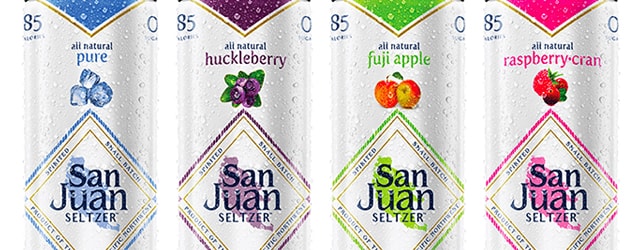
With more than 60 years of cumulative beverage industry experience on the team, San Juan Seltzer was able to master this phenomenal growth.
“What started as an occasional brew, quickly became brewing all the time,” says Frank Commanday, technical director, at San Juan Seltzer. Commanday has over 30 years of practical experience in the beverage production industry and has been with the company since its founding.
With production nearly doubling each year, it wasn’t only the frequency of brews that increased; volume increased 3-fold. It was soon apparent that manual loading the cane sugar into the brew house mixing tank bag by bag was no longer practical.
With larger batches, a single fermentation run required just over three tons of cane sugar to produce the alcohol base for its spiked seltzers. “Manually loading 50-pound bags into tanks at that volume is just not workable,” said Commanday. “Not only is it inefficient and labor intensive, it is also potentially dangerous. Lifting and twisting risks back injury.”
Seeking a Solution

When seeking an automated solution, the seltzer producer had three primary considerations. First and foremost was to address the health and safety issue of workers manually lifting 50-lb sacks of sugar from a pallet up a flight of stairs to another worker on the platform, who had to open each sack and dump it into a mixing tank. The second was to free up personnel to perform other tasks. The third was to eliminate the need to bring pallets of sugar through the brewing area, where they impeded access to tanks, hoses and other equipment.
“Tried and true is the way to go,” said Commanday about choosing equipment. “First you look at the most common methods for a given operation, and then apply it to your process to meet operational goals and budget.”
In breweries, automating transfer of malted grains is commonly achieved with the use of low-cost augers. Commanday, however, discovered that augers could not handle granular sugar effectively, so he looked to the most common method of transferring granular sugar: vacuum conveying. “I contacted Vac-U-Max because it’s the original vacuum conveyor manufacturer,” said Commanday. “It has been around since the Fifties, with venerable, mature technology.”
With more than 65 years of experience in developing customized conveying systems across a wide range of industries, and testing more than 10,000 materials, Belleville, NJ-based Vac-U-Max has been at the forefront of innovative mechanical and pneumatic design with many firsts. Its systems perform sophisticated operations with little human assistance, delivering flexibility, integration, and efficiency to its clients.
With a history of working with major food and beverage manufacturers such as General Mills, Kraft Foods, and Kellogg Co., as well as many smaller specialty producers, Vac-U-Max has extensive knowledge in the design and construction of sanitary conveying systems that meet FDA and USDA standards.
Vacuum Conveying
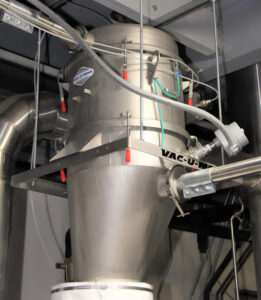
Vacuum conveying (aka pneumatic conveying) uses suction to transfer dry bulk materials and powders, gently and automatically through a tubing network easily installed within a facility. Versatile, small-footprint vacuum conveying systems easily integrate with existing processes by routing conveying lines between floors, through partitions, and around machinery, and can easily be re-routed to accommodate process modifications.
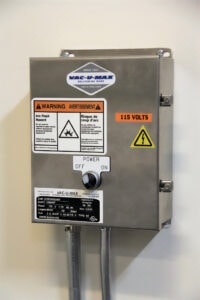
Vacuum conveying systems include a pickup point where material enters into the conveying system, convey tubing that transfers material between equipment, a vacuum receiver (aka filter receiver) that serves as an intermediate holding vessel for materials, a vacuum source that powers the system, and a control panel that tells the system how to operate.
Sanitary and hygienic vacuum conveying systems have the same five basic components as standard conveying systems but are constructed with materials and fabrication techniques that meet Current Good Manufacturing Practices (cGMPs).
The pick-up point is the most customized component in a vacuum conveying system and is dependent upon the type of container that holds the transfer material. This dictates whether the pick-up point in a conveying system is a wand, a bag dump station, a bulk bag unloader, or a feed bin.
After choosing a Vac-U-Max system to automate the process of discharging sugar into the mixing tank located in the brewhouse area, with the pickup point in an adjacent room, Commanday chose the best alternative to 50-lb bags for its process.
Bulk Container Options
Automating manual materials handling with vacuum conveyors provides users with wider variety of bulk containers to best fit their unique process and budget. The seltzer company could have stuck with its 50-lb bags and added a bag dump station as the pick-up point, but doing it this way still required manual handling of 50-lb bags which the company wanted to eliminate completely.
For the seltzer manufacturer, 2,000-lb flexible intermediate bulk containers (FIBCs), or supersacks, were the most economic and efficient way of storing and transporting sugar for its process. With 2,000-lb supersacks, Commanday had the option of suspending them from a customized bulk unloader with a rotary valve metering the sugar into the vacuum conveyor.
Bulk bag unloaders provide an easy, clean, and economical way to discharge the entire contents of bulk and semi-bulk bags, especially when the material is less than free flowing. Vac-U-Max customizes each bulk bag unloader to integrate with a customer’s process.
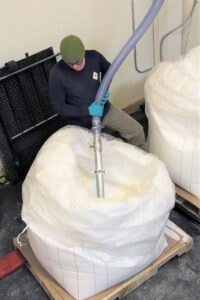
In situations where space and/or cost are considerations, the use of a wand, inserted into a supersack (moved into position with a pallet jack or forklift), provides the simplest solution. Commanday opted for the most inexpensive, low-tech method, using a stainless steel wand to draw sugar from the top of the supersacks into the vacuum conveying system. “A single operator holding onto the wand is far better than having two people lift, carry, load, open, and dump 120 50-lb bags,” he said.
Labor Savings & Improved Working Conditions
While automating the loading cycle with the vacuum conveyor did shave a little time from the process, the real savings came in terms of labor. “I suppose you could say that it takes half the time now since it only requires one operator and not two,” said Commanday. “But the best part is, is that you don’t have people ruining their backs or having to contend with pallets blocking the production area, so the Vac-U-Max system is far more efficient overall. I also really liked and appreciated the service that I got with Vac-U-Max.”
Following Up
After nearly two years in service Commanday emailed Vac-U-Max with questions about his system. Although it had been performing well, caked sugar had accumulated around the filters and the vacuum gauge read 4 in. of suction without a load, indicating some blockage of the filters.
The solution was simpler than he anticipated. The filters are cleanable in-situ with warm water and then left to dry. “Those seven filters are robust, they aren’t going collapse, they don’t need to be changed all the time, and they are efficient,” said Commanday. “It will be a long time before we need to replace them.”
“The Vac-U-Max system has been a real workhorse. It is robust, low maintenance, and very simple to use.”