

What You Need to Know When Choosing Pneumatic Conveyors
Tech Article
You don’t need to become an expert at system design to integrate pneumatic conveyors into your line; you simply need to understand your own process.
Every manufacturing process is unique and a multitude of factors come into play when designing a pneumatic conveying system, many of which are hidden from the greenhorn. For example, two manufacturers might use the exact same material, and even share some common equipment, but factors unique to each manufacturing plant will require tweaks. Even between twin plants where equipment configuration is identical, a single factor—such as humidity—can alter the manner in which a system operates and slight adjustments may be necessary to archieve optimum performance.
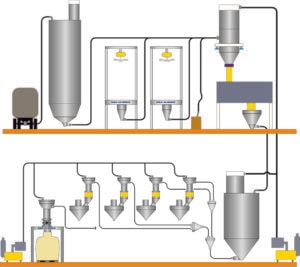
When implementing pneumatic conveying equipment, plant managers, maintenance managers, and engineers are seeking a system that functions flawlessly 24/7 with minimal attention. Partnering with the right manufacturer—one with a deep knowledge of material characteristics and a firm grasp of the fine points of pneumatic conveying can make or break a system that system.
Peak performance is an art.
It has been argued that pneumatic conveying system design is more art than science, drawing upon decades of experience to augment scientific principles. While it is true that many conveyor manufacturers use programs to jump start the design of complicated systems, in the end it is the expertise gained through years of applied practice that guarantees an efficient design.
It is this expertise that allows conveyor manufacturers to resolve seemingly impossible problems. A fairly recent example of this came in the testing phase where a customer wanted to automatically feed a material into the conveying system without needing an operator to manipulate a wand. The difficulty was not in conveying the material, but getting it to automatically feed into the conveying tube.
Part of the solution came from a previous application to handle powdered sour cream. Although the makeup of the materials is completely different, one being a food product and the other an exotic chemical powder, the characteristics were similar, and that knowledge allowed us to resolve the issue.
In difficult situations, because we know how something is going to work, we can take our standard equipment that is an 80 percent fit and then fabricate the other 20 percent to perfect the application.
Do what you do best, and we’ll handle the rest.
While a general understanding of how pneumatic conveying systems operate can be beneficial to users, it is not necessary for those charged with purchasing a system to become pseudo experts in the science of pneumatic conveying. What is necessary is a clear understanding of the desired goal with pneumatic conveying. Some users want more automation, others are seeking to improve ergonomics or create a cleaner work environment, for others increased throughput is the primary objective.
In addition to knowing the goals of implementing a pneumatic conveying system, users also need to know and relay a host of additional factors that will help the conveyor manufacture create a custom or semi-custom system that delivers the desired results.
Know your material.
Material properties, such as bulk density, particle size and shape, as well as knowing whether the material is abrasive, fragile, dusty, cohesive or hygroscopic, have a significant influence on system sizing and type of method used to convey materials.
In vacuum conveying air is necessary to get product through the conveying lines. If there is too much air, the product runs too thin. Reducing the amount of air allows more product to be pulled through the tubes. An everyday example of this is sucking liquid through a straw. If a straw is put inside a vessel and then one sucks, the straw is filled with liquid because there is little air; but, if the end of the straw is placed at the top of the liquid, the sucking action will pull mostly air through the straw and very little liquid.
In the most simple terms, dilute phase conveying injects more air into the conveying line (like the straw placed at the top of the liquid) and dense phase injects less air and more product into the conveying line (as the straw immersed in the vessel).
The majority of pneumatic conveyor applications are dilute phase systems, but dense phase systems are used as application dictate. In addition, there are some instances where semi-dense or semi-dilute systems are appropriate. Dilute phase systems employ higher velocity rates than dense phase systems.
Know your space.
Additionally, pneumatic conveying systems can be either negative or positive pressure systems. Negative pressure systems suck the material through the lines while positive pressure systems blow, or push, material down the line. The choice between negative and positive type systems is dictated by factors other than material characteristics such as conveying distance, and the need for higher conveying rates.
Besides knowing the conveying distance, both vertical and horizontal, users will need to inform the conveyor manufacturer about the number of pick up points, the container the material is fed from, whether or not the process is continuous, the feed rate, and if it is a batch process how often and the size of the batch.
Think about pickup points and levels of automation.
Deciding on the level of automation is another factor that will dictate the sophistication of the system. It can be said that no process is truly automated because there is always a little manual operation involved and therefore we tend to think more in terms of how sophisticated someone wants the system
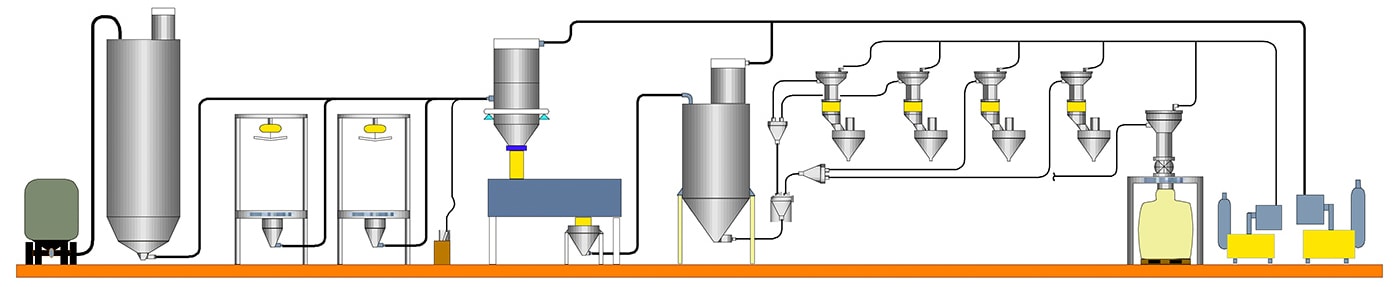
For instance, when packaging salt into individual serving sizes using a high speed filling machine, the material may come in drums and needs a way to get into a packaging machine hopper. One way of doing this would be using a vacuum conveying system to suck the material out of the drum and discharge the material into the hopper filling machine. That is somewhat automating the system because you are automatically transferring the material, but an operator still has to manually move the wand in the drum to get the material to convey.
One alternative to remove the manual labor would be to dump the drums into a larger container, or hopper, and let the material flow by gravity into the conveying line from that larger container, but in order to get the material into the larger container from the drums, there still has to be some sort of manual labor; however, when implementing pneumatic conveying systems, labor is almost always reduced.
Know where your material is going.
It is also important to know the type of equipment the pneumatic conveying system will be discharging into, including the manufacturer of that equipment. Experienced pneumatic conveyor manufacturers not only understand how their equipment performs under certain conditions, but also how it interacts with other equipment.
Hire an expert.
There are a multitude of factors that need consideration when designing a pneumatic conveying system, and this article has only addressed a handful. Just as plant managers, maintenance managers, and engineers are experts at producing their products, pneumatic conveyor manufacturers with decades of industry experience are experts at designing systems that meet the needs of their customers.