

The Basics: An Overview of Vacuum Conveying
Tech Article
How does vacuum conveying work?
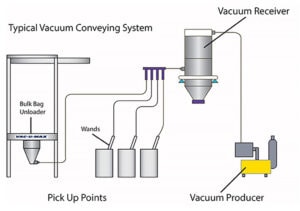
Simply put, vacuum conveying (aka pneumatic conveying) is the process of moving bulk dry materials from place to place using suction. Material is transferred from the pick-up point (or source), through a network of tubing to the vacuum receiver, and on to the customer’s process. Most vacuum conveying systems transfer product to the vacuum receiver based on a timed interval. At the end of the timed sequence, the discharge valve opens and the conveyed material discharges into the process.
Because they can be made to USDA sanitary standards, pneumatic conveying systems are popular in the food, pharmaceutical, and chemical industries. Applications can include loading a mixer, tablet press, volumetric or gravimetric feeders; feeding into a packaging machine; or any other application where bulk dry powders need to be introduced into to the process.
There are two types of vacuum conveying. Dilute phase conveying and dense phase conveying.
- Dilute Phase Vacuum Conveying: As the name suggests, the material is entrained in the air stream (suspended in air) and is almost equal parts air and product. This method is excellent for conveying almost any type of non-abrasive powder, like sugar or flour.
- Dense Phase Vacuum Conveying: In dense phase conveying, the material is transferred in slugs (clumps or plugs) within the convey tubing. The material moves more slowly, making it an excellent choice for delicate, friable product or blends of powders.
Do I have to know exactly what I need before contacting you?
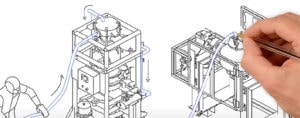
No! We don’t expect you to be a an expert in the field of vacuum conveying. What we need is for you to be an expert in your field, your facility, and your process. With that information, we can work together to dial in the system that will best fit your needs, location, and budget. Here are the ten main factors that we take into account when customizing a solution for a client:
- Material Bulk Density: Density is a good first design indicator when it comes to component size and air volume flow rate.
- Conveying Distance: Knowing how far your material needs to travel (and if it’s got any 90-degree sweeps along the way) helps us determine the required airflow to move the product to your exact specifications.
- Conveying Rate: How many pounds of material do you need to move per hour?
- Batch vs. Continuous Conveying: Do you require precision weighing? A delicate touch? A steady, uninterrupted supply of material into the supply line? This, along with the convey rate, has a significant effect on the size of the system.
- Material Characteristics: Is your material gossamer fine? Friable? Sticky? Heavy like mud? We have worked with over 10,000 materials over the years, and you’d be surprised at how the subtlest variation can make a difference when it comes to the fine tuning of a system.
- Material Container: Is the material coming to you in drums, bags, bulk bags, etc?
- Pick-Up Point: How do you plan to feed the materials into the line? We can help you determine which pickup method is best—wand, bulk bag unloader, docking station, etc—and, if needed, we can customize the pickup point to ensure max flow, efficiency, cleanliness, and safety.
- Process Equipment: Feeders, mixers, extruders, fillers… Where’s the material headed?
- Headroom: How much height do you have to work with?
- Plant Site & Industry Environment: Are you at altitude, in a humid climate, near a body of salt water? All of these factors and more can affect the flow of a material!
Want to learn more?
Read our article Top 10 Considerations for Pneumatic Conveying System Design.
Advantages of a VAC-U-MAX Vacuum Conveying System
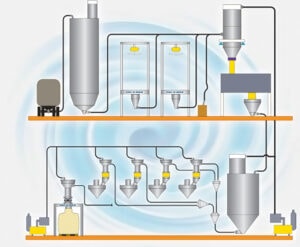
Pneumatic conveying has many benefits, from safety and compliance to improved product quality, a more streamlined workflow, and lower overhead.
- Dust-free transfer of powder. As opposed to positive pressure conveying where leakage is outward, vacuum conveying pulls inward, keeping the dust within the system, minimizing dust, and preventing product loss.
- Easy to clean. VAC-U-MAX vacuum conveying systems are designed to be easy to disassemble – no tools needed.
- Small footprint. When using a vacuum conveyor, the tubing or hose takes up little or no floor space within your facility, allowing you to maximize your space and freeing up the floor.
- Efficient conveying method of powders. Pneumatic conveying offers you greater control, precision, and consistency, and can often handle a higher volume of material.
- Easy to install. All VAC-U-MAX systems are pre-assembled and shipped for easy installation when they arrive at your factory. Most VAC-U-MAX vacuum receivers are also equipped with a suspension frame that allows for support from above or below.
- Low power consumption.
- Improved ergonomics. Pneumatic conveying can protect workers and save on injury costs by eliminating the need for heavy lifting, scooping, and climbing.