

Pneumatic Transfer of Dusty Powders for Compounding & Extrusion Processes
Tech Article
10 things you need to know when designing a vacuum conveying system to handle dusty powders and other granular bulk materials.
Application
Utilizing pneumatic conveying for “receipt-to- process transfer” of dusty powders and other granular bulk materials
Background

As all processes vary, so does the technology used to move bulk materials from source to destination. Typically in pneumatic conveying applications there are two types of technologies, Dilute Phase Vacuum and Dense Phase Vacuum. In Dilute Phase Vacuum Conveying, the bulk materials are entrained in the air stream. Up to 25,000 lbs per hour (11,000 kg/hr) of bulk materials can be moved, for distances less than 300 feet (90m).
Typically the line sizes for these applications are up to 6” (150 mm). In Dense Phase Vacuum Conveying applications, the conveying velocity is lower, ideal for moving fragile bulk materials, for minimal product degradation. Typically these applications are higher volume, up to 29” HG (982 Mbar). Dense Phase Vacuum Conveying is also used to convey powders to tanks under level of fluid. Typically these applications are higher volume, up to 29” HG (982 Mbar). Dense Phase Vacuum Conveying is also used to convey powders to tanks under level of fluid.
Technology: Dilute Phase Positive Pressure vs. Dense Phase Positive Pressure
Pneumatic Conveying technology is further broken down, to Dilute Phase Positive Pressure conveying and Dense Phase Positive Pressure conveying. Typically Dilute Phase Positive Pressure conveying is used for applications requiring higher rates and longer distances. This technology is also best suited for applications requiring conveying to multiple destinations, from one pick up point, or many pick up points. In this application, leakage of bulk materials is outward, and not recommended for combustible dusts, as noted by the NFPA. Dilute Phase Positive Pressure conveying is typically lower pressure, below 15 PSI (1 bar).
Dense Phase Positive Pressure conveying is also known as “brute force” conveying. In this application, a lot of compressed air is used to move the bulk materials over longer conveying distances. This is the preferred technique for friable bulk materials, with pressures above 15 PSI (1 bar).
Process: Basic Components of a Vacuum Conveying System for Dusty Powders & Additives
- Tubing or Flexible Hose: Hoses must be statically grounded, made from aluminum or stainless steel, with stainless steel preferred since it is more abrasion resistant. Never use plastic tubing.
- Filter Receiver Types: Conical or Offset Filter Receivers with steep angled hoppers allow full material discharge in mass flow. Tube Hoppers are straight vacuum receivers with no cone, ideal for non-free flowing powders.
- Vacuum Source: There are three types of vacuum sources available depending on application, Venturi, Regenerative Blower, or Positive Displacement Pump. The Venturi runs on compressed air, with no moving parts. This option is inexpensive up front, but over time can be costly. The Regenerative Blower offers low vacuum with high air flow. This option is ideal for applications requiring the conveying of pellets and granules. The third option is a Positive Displacement Vacuum Pump, and known as the work horse. This option is ideal for conveying any type of bulk material.
- Controls: PLC based control packages with timer boards or pneumatic controls. VAC-U-MAX is a UL-Certified Control Panel manufacturer.
- Air-to-Cloth Ratio: The amount of air (CFM) in relation to the amount of filter area (ft2) in the vacuum receiver. When conveying dusty powders, the lower the Air-to-Cloth ratio, the better the efficiency of the system. A lower ratio means more filter area, and more filter area means less chance for filter bypass.
- Loss-in-Weight Feeder Refill: This type of application allows for conveying and discharging on demand. When conveying on demand, the gravimetric or volumetric feeder signals for material to the conveying system, for conveying to begin. For volumetric feeder applications, the signal is typically a level controller. When the vacuum receiver is full, we are discharging on demand. The feeder sends a refill signal to the vacuum receiver, and the discharge valve opens with material discharging via gravity into the feeder. The vacuum conveying system then conveys more powder to the vacuum receiver, with the system in standby mode until a refill signal is sent.
- Specialty Bag Dump Stations for Non-Free Flowing Dusty Powders: VAC-U-MAX systems incorporate specialty bag dump stations designed with integral dust collectors and live hopper bottom, ideal for non-freeflowing bulk materials.
- Vacuum Receivers: The Heart of a System: Vacuum Receivers should be customized based on the application, material conveyed, rates, and distances. Receivers are designed to hold enough material to refill loss-in-weight feeders, or any “Discharge on Demand” systems. As most powders are not free-flowing, considerations should be made whether a tube hopper is appropriate, to ensure that the powder is completely discharged. In some instances, large area cartridge filters are an option, with air-to-cloth ratios of 7:1.
Ten Things to Consider When Designing a Vacuum Conveying System
1. Know the Bulk Density
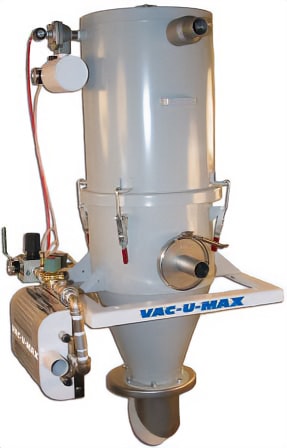
The Bulk Density of a powder is different then the bulk density of glass fibers, or flakes like PTFE bottle flakes. Bulk Density is measured in pounds per cubic foot or gm/cc. To convert from gm/cc to #/ft2 multiply by 62.43. Doing this helps calculate the size of the vacuum receiver, as well as the size of the vacuum power unit and how much CFM is needed.
2. Conveying Distance: Horizontal or Vertical?
When designing a pneumatic conveying system for handling various powders, dusty powders, or granular bulk materials, find out how many 90 degree sweeps are needed. Typically one sweep equals 20 feet of linear tubing or pipe. For example, 20 feet vertically, and 20 feet horizontally. In batch or continuous systems, watch for in-flight bulk material that may fall back down into the conveying line. A line clearing valve is recommended. It is also best to keep pipe routing as short as possible, with few elbows. Back-to-back elbows should be avoided, and lines should be purged after each cycle.
3. Know the Conveying Rate
When designing a pneumatic conveying system, it is important to know how many pounds/kilograms per hour will be conveyed. It is also important to know whether the application is a batch operation. For example, if the application requires to convey 2,000 pounds per hour, but actually the process requires conveying 2,000 pounds once an hour in 5 minutes, the actual resulting convey rate is 24,000 pounds per hour.
4. What are the Material Characteristics?
This is the most important step when designing any process automation solution. Find out if the powder or bulk material is free flowing, cohesive, is it a powder, a pellet, flake, granule, glass fiber, or hygroscopic. Bulk material evaluation includes finding the bulk density, flow angles, sieve analysis, can velocity, terminal velocity, bulk velocity, fluidity, abrasion, and particle shape.
It is important to know that the characteristics of powders vary from fluidizable to bridge-building. Powders can be free-flowing, cohesive, to very abrasive. Typical filler powders such as talc or calcium carbonate, are received via bag dump station or bulk bag unloading station. A fluidizing cone, rotary valve, or volumetric pre-feeder assist with the movement at the pick-up point.
5. How is the Bulk Material Received?
Typically any type of powder or bulk ingredient is received in an bag, drum, bulk bag or FIBC (flexible intermediate container), RIBC (Rigid intermediate container), Mixer, Silo, or Day Bin.
6. What is the Process Equipment?
Find out if the bulk material is being conveyed to a loss-in-weight feeder, volumetric feeder, mixer, extruder hopper, reactor, blender, or other related equipment. Keep in mind that upstream equipment effects downstream equipment. The more that is known about the process application, the better. For example, knowing what process equipment is being loaded beforehand, like a loss-in-weight feeder that needs to be refilled quickly, effects the design of the system.
7. How Much Headroom is Above the Process Equipment?
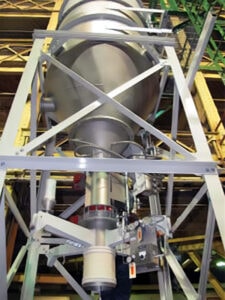
It is important to know how much headroom is available above the process equipment. Even the smallest vacuum conveying system for powders will require at least 30” of headroom. Headroom constraints can be worked around. Cyclones or filter-less vacuum receivers can be employed, or scaling valves and even positive pressure systems.
8. Is the Process a Batch or Continuous Operation?
Typically in an extrusion process, the process automation system will be a batch operation. The process equipment is loaded either via a volumetric or loss-in weight feeder, with feeder metering the powders, additives, etc. continuously into the extruder.
9. Geographically, Where is the Plant Site Located?
It is important to find out how many feet above sea level the site is located. The higher the elevation, the less air, and this effects the vacuum source sizing. For example, if a factory is located at shore points, or at sea level, a 5 HP vacuum pump may be used. A factory in Denver, Colorado may require a 7.5 HP vacuum pump.
10. Material of Construction Requirements
Before designing any process automation solution, it is important to know the material of construction, specifically carbon steel, stainless steel (304 or 316L), or pharmaceutical sanitary grade.
By properly defining these points, processing and production operations will be maximized, ultimately improving end-product cost savings and energy efficiency. It is always important to check all convey lines for leaks, this is the main cause of wasted energy. Each system should be tailored for a pick-up velocity specific to the material characteristic. Doing so avoids material build-up in the line, and potential higher energy consumption. It is also important to make sure all filter elements are clean, and make certain that the system is not running after the hopper is emptied, again potential for unnecessary energy consumption.
There are many factors that need consideration when designing a pneumatic conveying system, particularly when conveying dusty powders. There are many types of pneumatic conveying systems available, including vacuum/pressure, continuous vacuum, continuous pressure, weighing / scaling, vacuum sequencing and closed-loop systems. Just as plant managers, maintenance managers, and engineers are experts at producing their products, pneumatic conveyor manufacturers with decades of industry experience are experts at designing systems that meet the needs of the application.