

Key Components for Pneumatically Conveying Difficult Powders
Case Study
Fine-tuned flow promotion devices, suitable filters, filter placement, and vacuum receiver design ensure peak system performance.
When it comes to difficult powders such as iron oxide, zinc oxide, titanium dioxide, carbon black, calcium carbonate, or toner, the challenge does not lie so much in conveying through the material line because, generally speaking, once the material is entrained in the line, it has become fluidized and moves freely.

While there may be problems in the tube (e.g., a sticky, platelet-like particle like titanium dioxide building up in the line), agitator devices can be used to break the material free.
The main challenge when conveying difficult powder is actually getting the material to feed at a constant rate—both into the material line from the pick-up point and again when discharging from the material receiver.
Cohesive and lightweight powders are prone to sticking and can cause choking and bridging. Steady product flow into the material line and a proper solids-to-air ratio are critical with sticky materials. If the solids-to-air ratio is too high, the line will plug; if it’s too low, you’re just sucking air and not transporting much material.
For materials with poor flow properties, extra attention needs to be focused on specially devised flow promotion devices, suitable filters, filter placement, and vacuum receiver design.
Flow-Promoting Feed Devices
The pick-up point is where material feeds into the tubing network that leads to the vacuum receiver. The pick-up point could be a bulk bag unloader, bag dump station, or a wand that an operator inserts into a drum. With difficult powders, specially designed flow-promoting feed devices regulate this flow, helping the material enter into the line at a constant rate. These devices are most often some type of vibratory device, but rotary or screw feeders are sometimes used where applicable.
Zinc oxide and iron oxide are particularly nasty materials to convey due to their very poor flow properties—one could even liken them to conveying mud. In one application, iron oxide was being transferred to a mixer reactor from 50-pound bags using a bag dump station. Normally, with a bag dump station, the operator places a bag on the shelf of the station, cuts the bag open, and the powder falls into the collection hopper. It is then vacuumed from the bottom of the collection hopper into the conveying line.
In this particular application, the flow properties of the material were so bad that the material didn’t want to move. To get the iron oxide into the line, a specially devised live bin agitator—a hopper on rubber isolators with an oscillating vibrator to shake the bin—was implemented to facilitate material flow into a pickup adapter and into the airflow stream.
The bag dump station was also fitted with a unit that draws outside air inward to prevent dust from entering the environment around the operator. This is where filters come in.
Filters
At the top of the material receiver housing, filters separate product from the air traveling back to the vacuum producer. Improper filters can become coated with dust, hindering airflow, and choking the machine. With ultra-fine powders, filters can easily clog and choke the entire conveying process. Filter material, the number of filters, placement, and a proper cleaning cycle are all extremely important when it comes to difficult materials.
Carbon black is an ultra-fine powder, so fine that the running joke is that it gets into the wrinkles of your wrinkles. In one application, the task was to recover residual carbon black out of the bottom of rail cars and discharge it into super sacks. During the discharge cycle, only 2 to 3 pounds was dropping into the super sacks.

After testing with flow promotion, vibration, and various other tricks of the trade, it was discovered that the carbon black was getting hung up between the filter socks—even with automatic pulse filter cleaning. The final solution was to supply a new filter plate with fewer filters but just as much filter area to prevent the material from hanging up between filters.
For applications where there is not enough space above the receiver—such as direct charge loader blending or low clearance areas—vacuum receivers without filters can be used. The filters are then placed further down the line, a safe distance from the vacuum pump.
Receiver Design
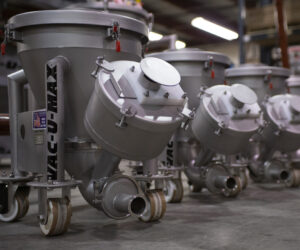
Angular surfaces provide areas where difficult materials can bridge or hang up. Supplying a straight-walled vacuum receiver eliminates sloped surfaces and allows positive discharge without requiring auxiliary vibration or agitation. This straight-wall configuration terminates in an automatic discharge valve the same size as the tube, permitting rapid passage of even the most difficult non-free-flowing material.
Tune and Test
Much like tuning a high performance race car, science and spreadsheets only get you so far. For true peak performance, it is essential to fine tune the system in person, testing with the client’s actual material and knowing which components will move the material most gently, reducing wear and degradation.
Every piece of equipment must complement the others. Vacuum receivers must be able to handle the airflow provided by the vacuum source, and the air-to-cloth ratio of filters must be balanced so filters don’t shred or blind.
Whether the application requires customized components or more economical plug-and-play solutions, a well engineered, fine-tuned pneumatic conveying system solves safety hazards, production slowdowns, and material loss while moving product gently and quickly from point to point—with nothing in the way to impede the efficiency of movement.