

Cost Considerations When Designing Pneumatic Conveying Systems
Tech Article
How Much Does a Pneumatic Conveying System Cost?
The cost of a vacuum conveying system will be dependent upon the parameters of the application, the volume of material to be transferred, and the amount of automation required in the system.
Balancing Cost & Process Requirements
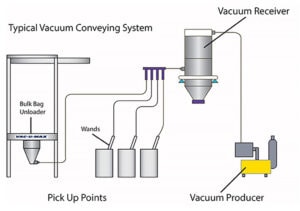
Each VAC-U-MAX vacuum conveying system consists of a pick-up point, a vacuum receiver, a vacuum producer and a UL certified control panel.
The pick-up point can be a wand conveying from a drum, a bag dump station, a bulk bag unloader, or even a truck or rail car.
Conveying from a container with a wand is a low-cost option where an operator moves a wand through the product in the drum, essentially sucking it up into the container. An operator can safely convey up to 5,000 pounds of material per hour (or even a bit higher) with a wand.
To achieve rates higher than 5,000 pounds per hour, however, material must be fed, by gravity, into the convey line, with one of the other methods mentioned above.
An operator dumping 50-pound bags into a bag dump station can achieve approximately 100 pounds per minute (2 bags per minute), while much higher rates can be achieved when discharging material from bulk bag unloaders.
Every steps of the system, and its cost, depends on your needs. Below is a brief description of each components in a vacuum convey system.
Wands: The wand is used primarily when conveying from drums or other containers. The operator inserts the wand into the container and the material is sucked through the wand into the convey line.
Bag Dump Station: Used to convey material from smaller bags, such as 25-kilogram bags, the operator lifts the bag onto the bag dump station grate, cuts a slit in the bag and then turns it over where material falls by gravity into the convey line. If material is not free flowing or is sticky then a screw discharger may be used to meter the material into the convey line.
Bulk Bag Unloader: Also known as a bulk bag discharger, bulk bag unloaders handle large super sacks (2000 pounds). Super sacks come fitted with a loading spout and a discharge spout. When a sack is placed on the frame, the operator unties the discharge spout to allow the material to flow by gravity to the convey line.
Tubing and Hose: Tubing and hoses are vital to a vacuum convey system as they transport materials from one point to the next. Tubing is always metallic and commonly stainless steel. Lengths of tubing are connected using compression type couplings; however, in sanitary systems, tubing is polished and connected using ferrules. Flexible convey hose is FDA and USDA accepted, smooth bore and static conductive. Never use non-static conductive hose or PVC tubing.
Vacuum Receiver: Vacuum receivers come in all different shapes and sizes. From .25 cubic feet to 500 cubic feet in capacity, vacuum receiver sizing depends on the bulk density and rate (pounds per hour) of the system. VAC-U-MAX offers vacuum receivers for all types of powders for the food, pharmaceutical and chemical industries.
Filters and Filter Housing Assemblies: Like vacuum receivers, the filters in a vacuum convey system depend on the application. VAC-U-MAX uses static conductive filters and our pulse filter cleaning system keeps the filters clean and the system running efficiently.
Vacuum Producers: Vacuum producers, or air movers, are the heart of the vacuum conveying system. VAC-U-MAX offers four options to create airflow in a system.
- Venturi Power Units – these operate using compressed air and have no moving parts. The VAC-U-MAX venturi power unit is a low-cost way to use a vacuum conveying system and easy to install.
- Positive Displacement Vacuum Pumps – using a rotary lobe pump belt driven by a motor the PD Pump creates the vacuum. Primarily used for dilute and semi-dense convey systems.
- High Vacuum Pumps – used for dense phase conveying where the material conveys in slugs through tubing.
- Regenerative Blowers – these are lower in vacuum and higher in airflow and are excellent for use when conveying granular or pelleted products.
Control Panels: If the Vacuum Pump is the heart of the system then the control panel is the brains. VAC-U-MAX is a UL Certified Builder of control panels and constructs them according to application.
Even the simplest systems utilize a micro PLC to control convey, discharge and pulse functions and more complex PLC control panels are furnished for more involved batch weigh systems and multi-ingredient handling systems.
Read more about system design and the costs-benefits of vacuum conveying systems:
- Meet Process Needs Without a Custom Design: Custom solutions are not necessarily required to solve your process needs. VAC-U-MAX’s turnkey pre-engineered packages descend from decades of custom-engineered solutions and satisfy a good 80% of the powder and bulk solid challenges out there.
- Reducing Costs with Pneumatic Conveyors: The flip side of the cost of a good pneumatic conveying system is the savings you will enjoy on the other side – reduced downtime, increased production, product reclamation, and more.