

A Road Map for Selecting Pneumatic Conveying Systems for Packaging & Refill Applications
Tech Article
Demystifying Pneumatic Conveying for Packaging & Refill Applications
It’s one thing to move materials during the production process, but when it’s a finished product on the packaging line, choosing the right material handling system is essential. Getting it wrong can result in squandered production time, product loss, and wasted raw materials.
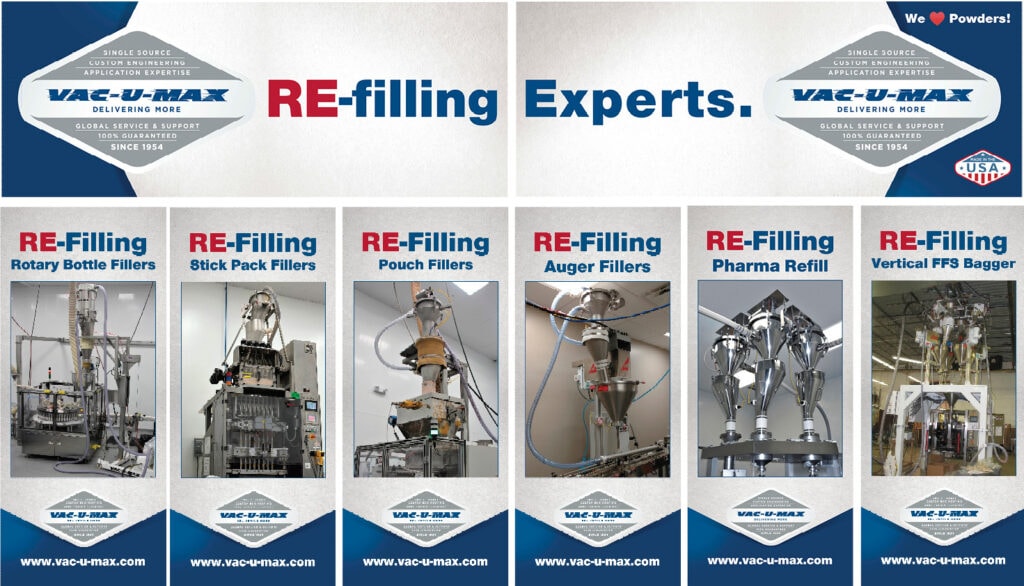
Pneumatic conveying systems are a viable option when moving product from the manufacturing line to the packaging line, but often choosing the right system can feel overwhelming. We will walk you through the process.
Just as there are various factors given consideration when planning a route to a destination—time, distance, conditions, purpose and safety—there are many factors to take into account when designing a pneumatic conveying system to deliver a finished product to a packaging line.
In packaging operations, the most common pneumatic conveyor systems are vacuum conveying systems, but before heading into that topic, a basic understanding of the components that make up a pneumatic conveyor system is essential.
The Fundamentals
A standard pneumatic conveying system consists of five basic pieces of equipment that come together to work as one:
- a pick-up point;
- a convey tubing;
- a vacuum receiver;
- a vacuum producer, and;
- a control module.
The selection of a pick-up point depends on the type of container used to store materials or products. If the product is in drums or box, then a pick-up wand, inserted into the container, may be used to pull material from the container into the convey tube. When material is stored in bags, ergonomic bag dump stations that reduce spillage are often utilized. This allows the emptied material to flow by gravity into the vacuum conveying line. For supersacks or large totes, bulk bag dischargers are frequently the choice as a pick-up point.
From the pick-up point, material flows through convey tubes to the vacuum receiver. There are a number of different types and sizes of vacuum tubes that are utilized and chosen, depending upon application. Vacuum receivers transfer material from above the packaging machinery through discharge valves on the bottom. The material is conveyed from the pick-up point to the vacuum receiver until it reaches a pre-determined load, or is “made,” at which point the discharge valve opens and the material drops into the packaging machine.
Vacuum producers are the core of pneumatic conveying systems and work with the control panel to manage the flow of material through the convey tubes to the vacuum receivers. Two of the most common vacuum producers are Venturi powered units that run on compressed air, and positive displacement pumps that run on electricity; and, each has its advantages and disadvantages.
Download the PDF below to learn more.